A journey of observation through high-school math, solved by operating machines.
Here, an equation isn't a question to fill in. It's a mechanism to operate. Place gates at the zeros of a parabola to send a beam of light flying, add two waves to reach the lighthouse, open only the probability branches that fit the condition and count them. Predict, press Observe, adjust. 51 units and 153 stages from Math I to III, alongside the spirits that embody each technique.
Available in English for iPhone and iPad. The English edition for Android is coming soon. See the Japanese page
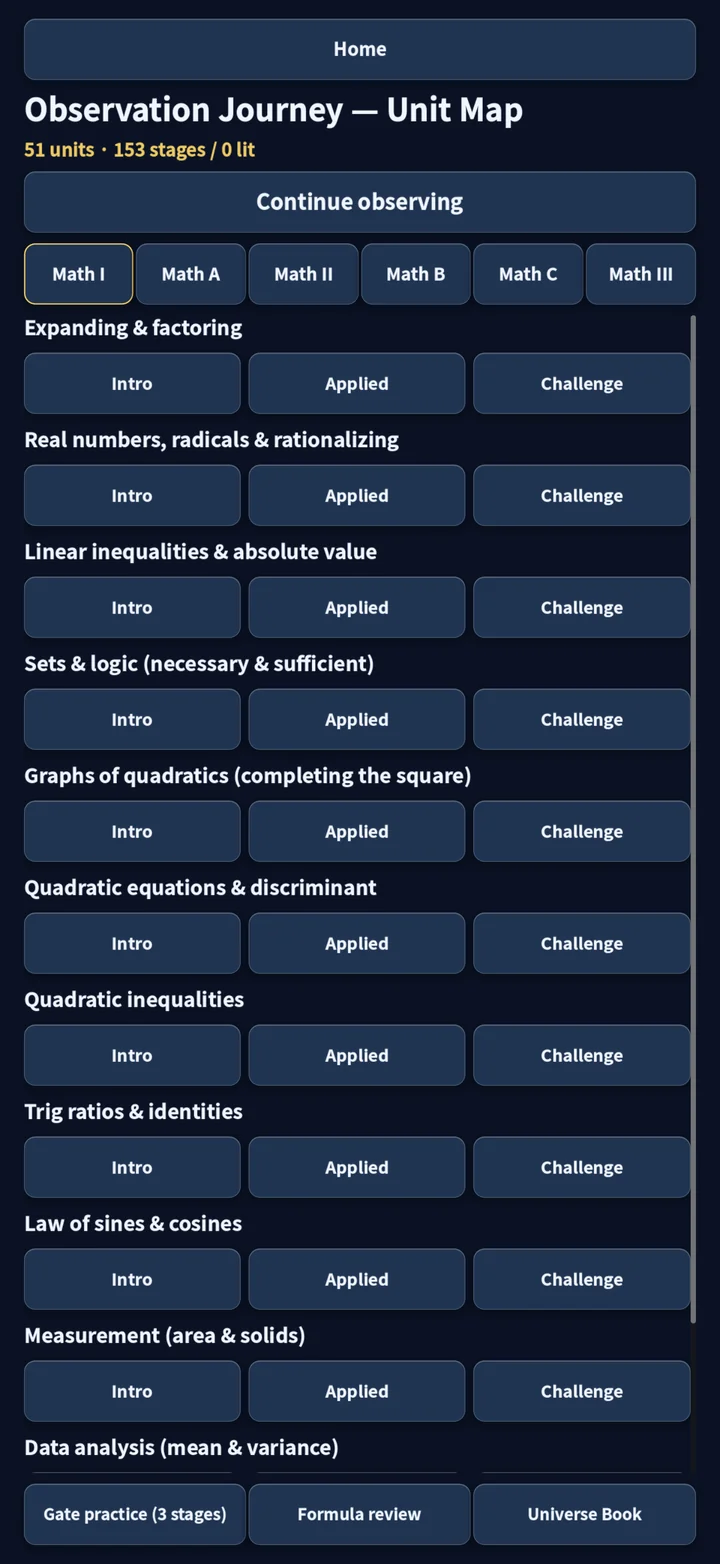
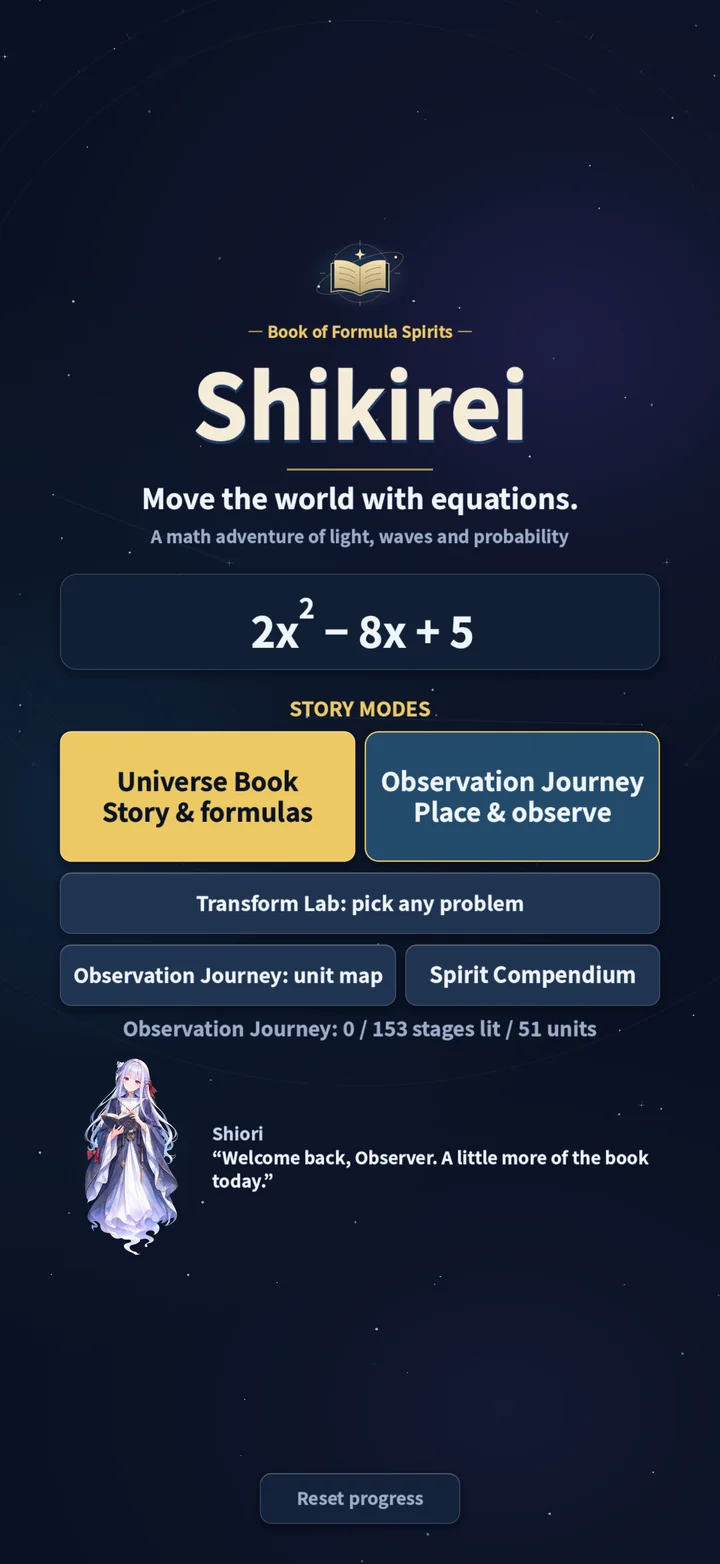
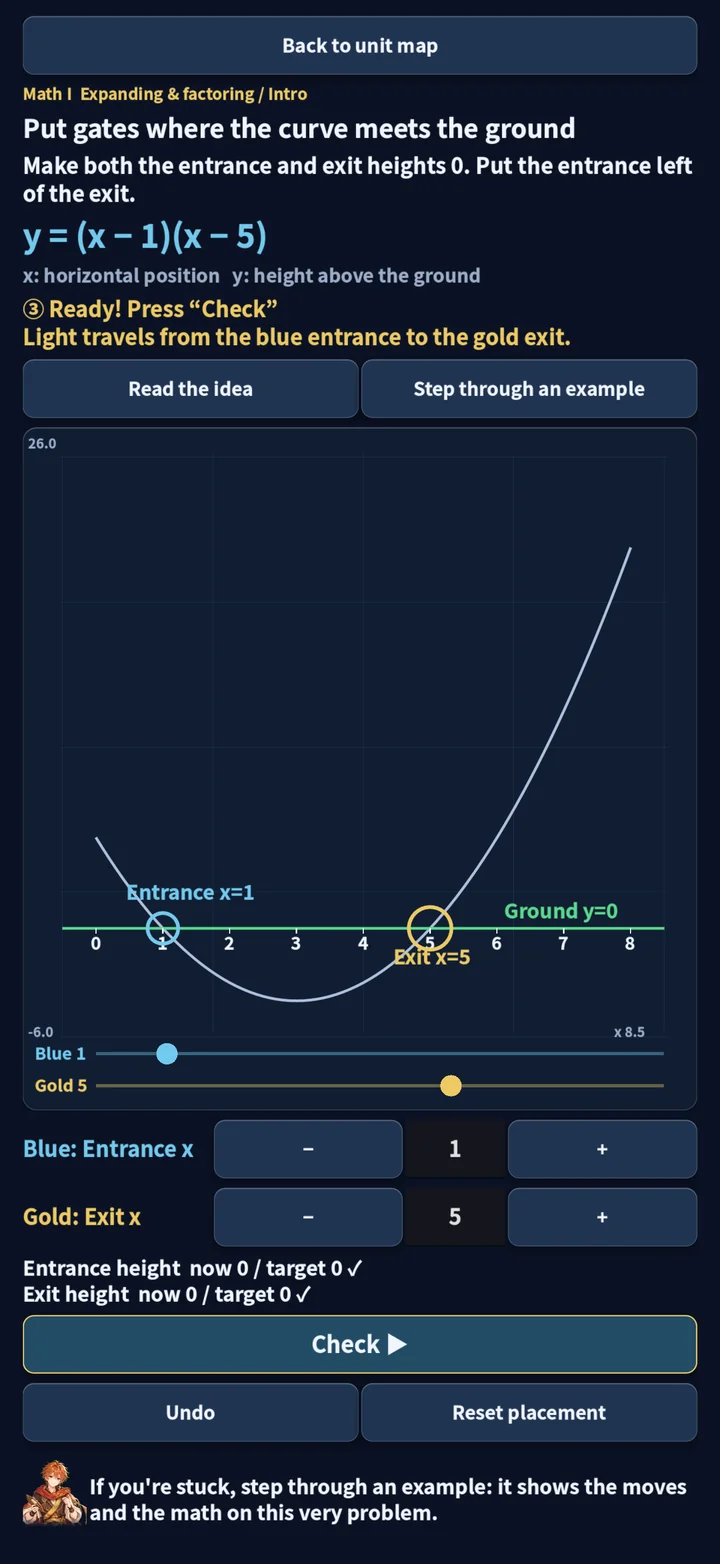
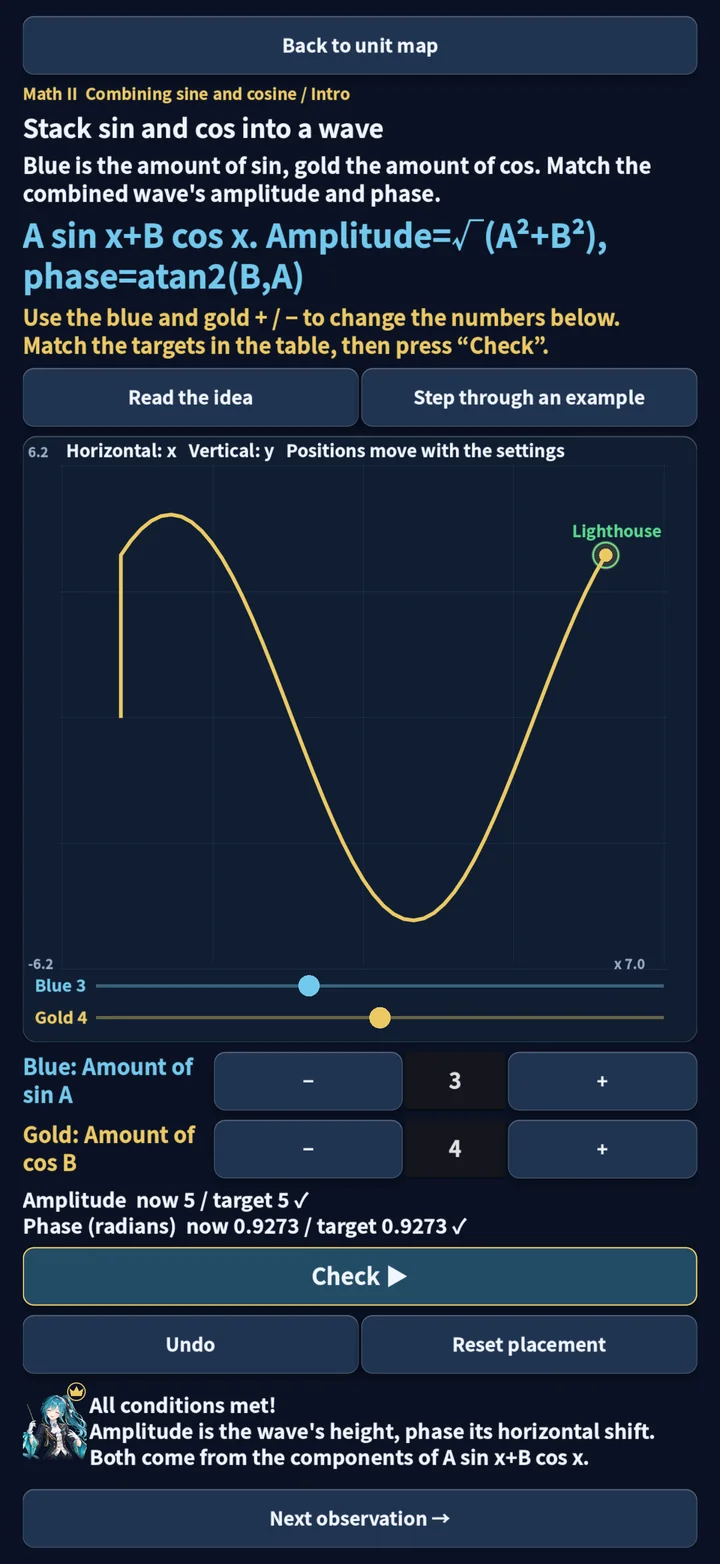
You never pick an answer from choices. Drag the controls, enter values, and press Observe to see where the light actually lands and which condition was broken. Predict, observe, adjust. There is no attempt limit.
Place gates where a parabola meets the ground and send a beam of light to the lighthouse. If a gate is off, you can see exactly where the light ended up, so you can work out for yourself where to move it next.
A sin x + B cos x. Match the two waves while checking amplitude and phase on the dials. Change a coefficient and watch the shape of the wave move in front of you.
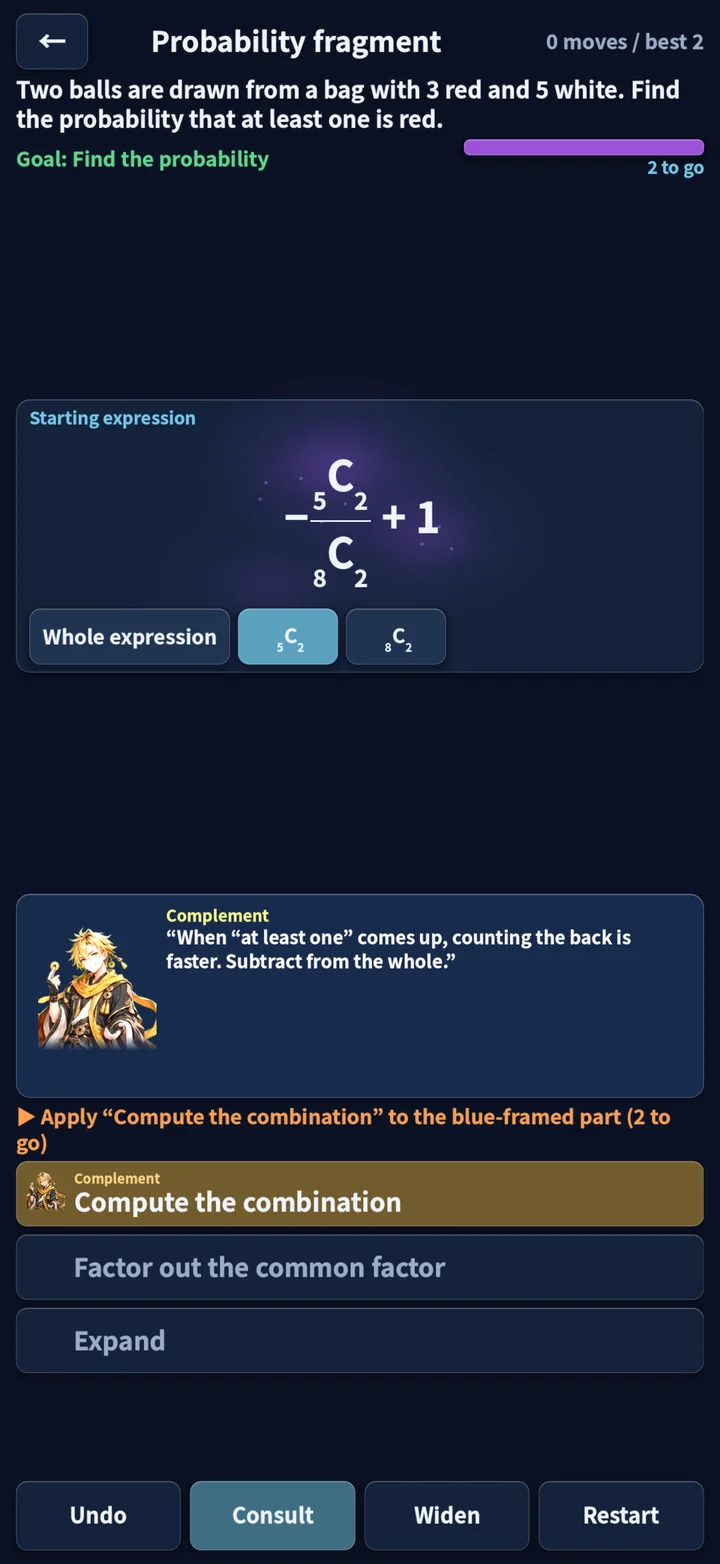
In conditional probability, you open only the branches that fit the condition and count them. "What goes in the denominator?" is answered right there by the branches you opened.
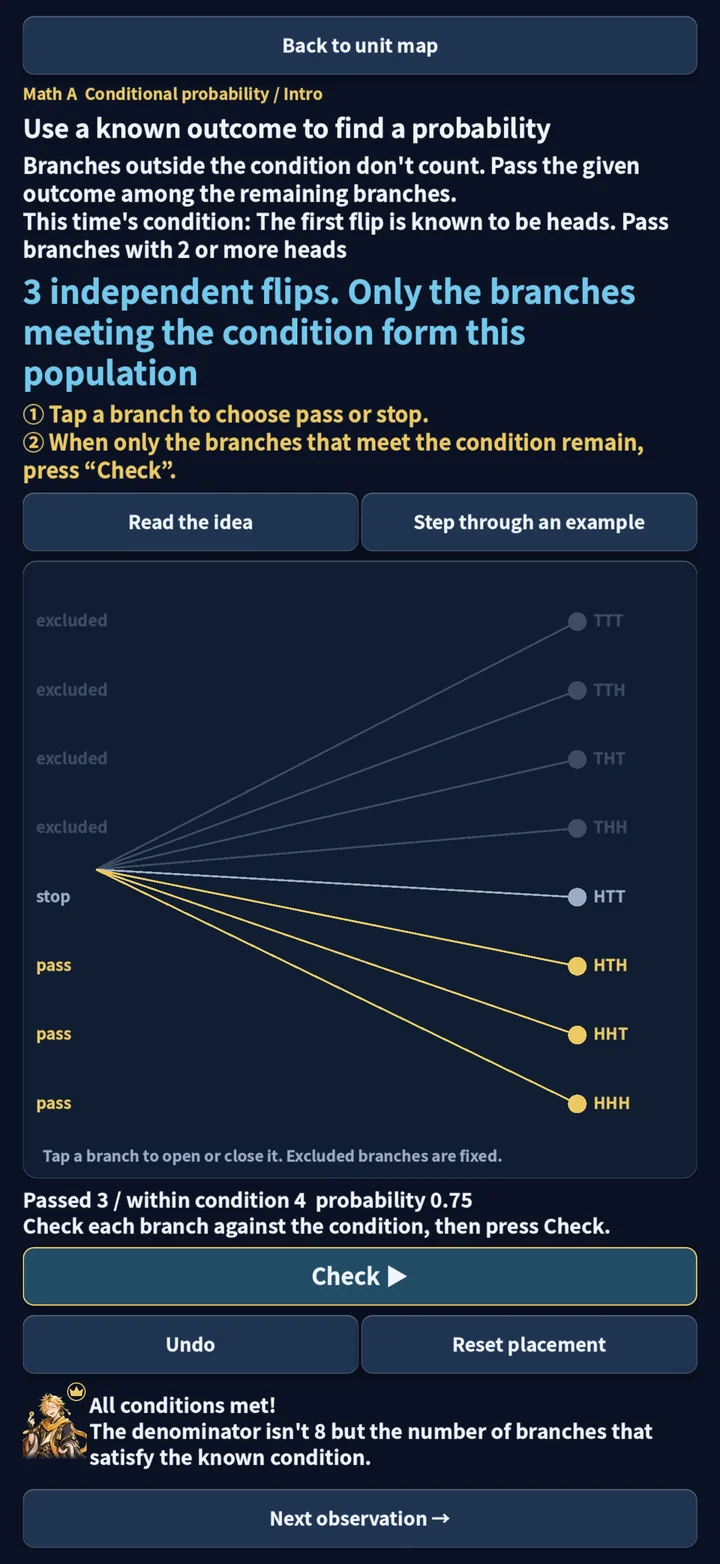
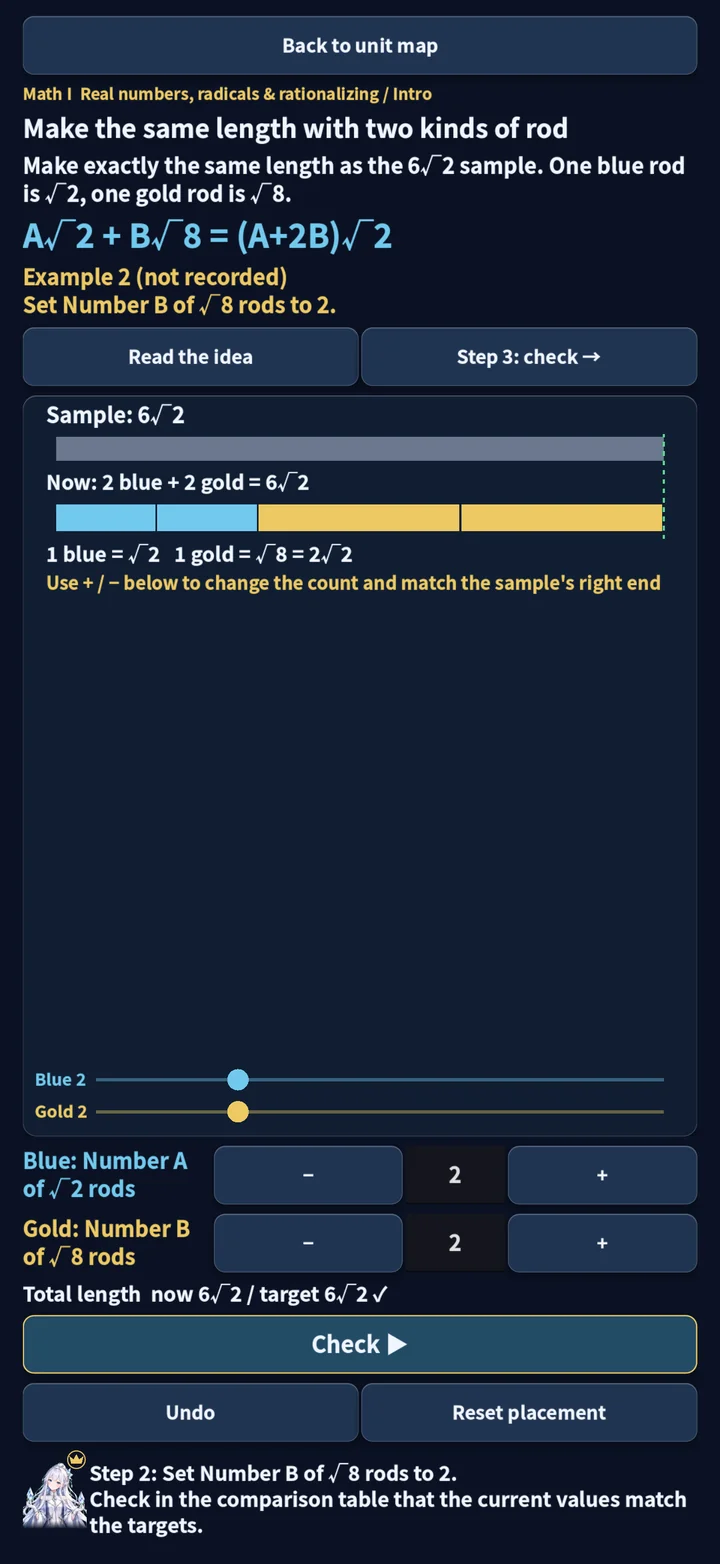
Open the reasoning on the board. The worked example shows each action and value in turn, but grants no reward while you watch: it's there so you can follow the order, not copy the answer. Ask the stage's spirit and you'll get a way of looking at the problem rather than the answer. Undo and reset are always available.
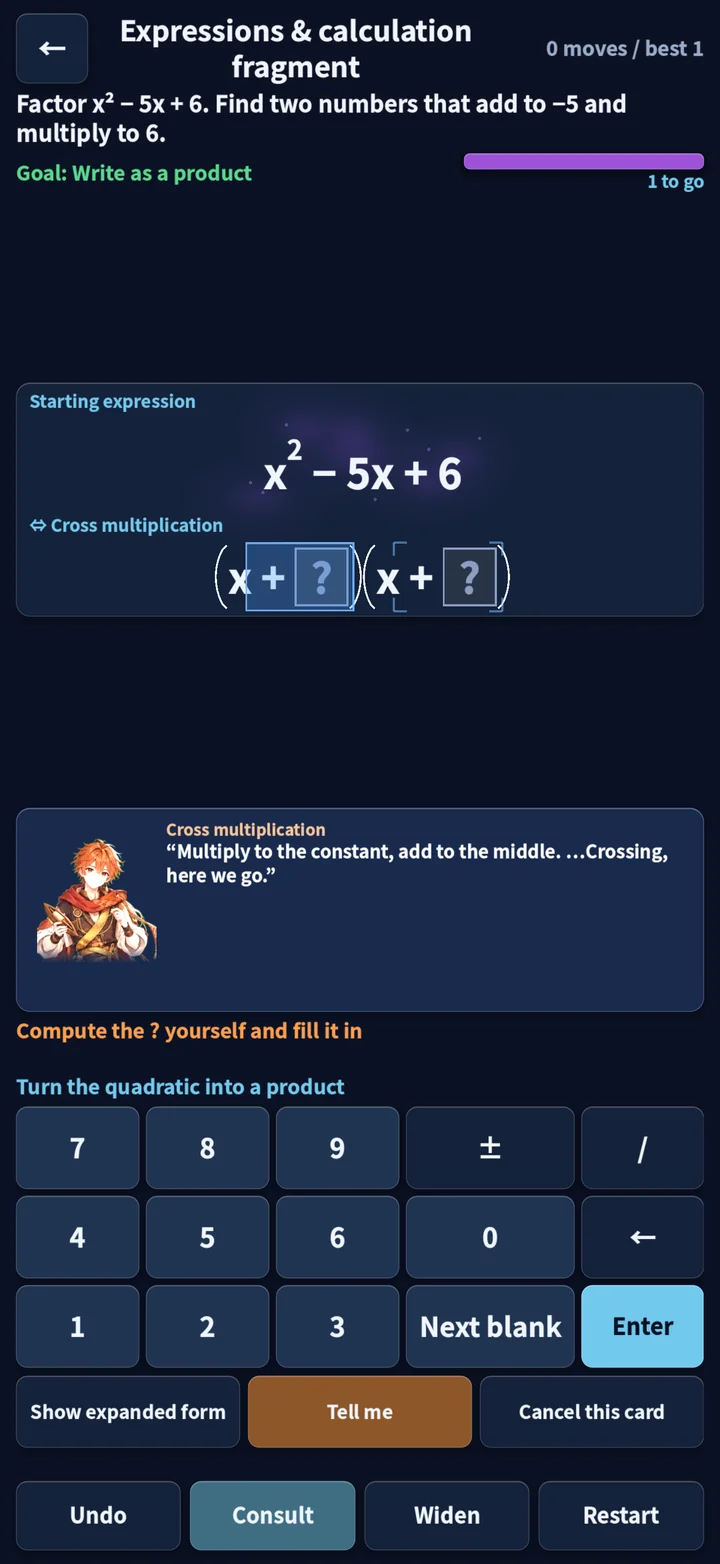
60 algebra problems across 11 layers. Each card shows only the name of a technique, such as completing the square, and the numbers it produces stay open as "?" in the expression. Those you compute yourself.
You work out these two yourself. Enter a negative value and it's rewritten as x − 2 rather than x + −2.
Answers are verified, not matched. The game checks that what you filled in expands back to the original expression, so (x−3)(x−2) counts too, in any valid order. You never have to learn how the app likes things written.
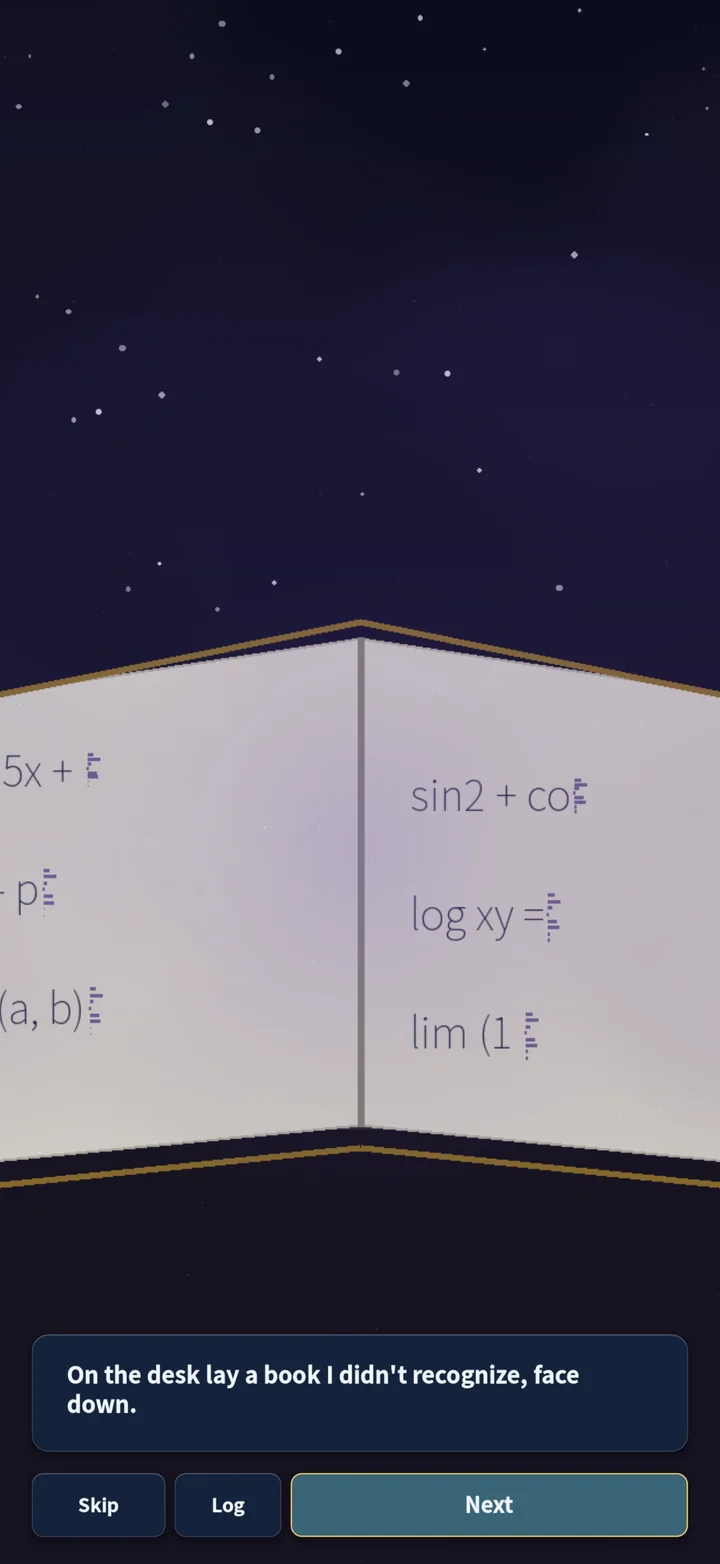
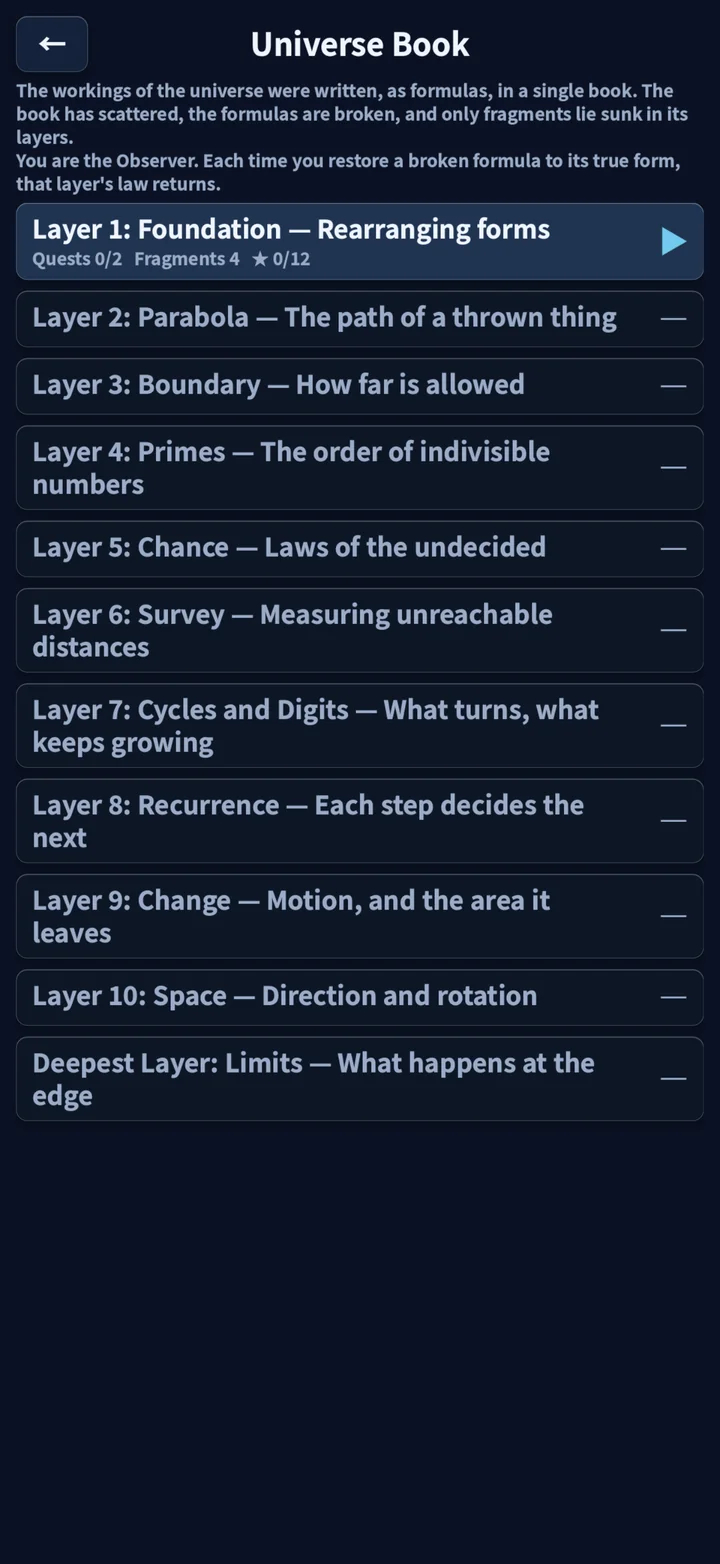
Noise is what has not yet been proven. The book is home to equations people have proven all the way through. Whatever remains unproven sinks into fog, and equations can't hold their shape there: that's what noise really is. Every equation you restore clears a little of it. At the bottom of the 11 layers you meet the limit, a value that is fixed even though you never arrive. A fact of mathematics becomes the ending of the story.
This framing isn't decoration. A parabola really is the path of a thrown object, trigonometry really did measure the distance to the stars, and on the complex plane multiplication really is rotation. The order of the layers is the order in which mathematics builds on itself.
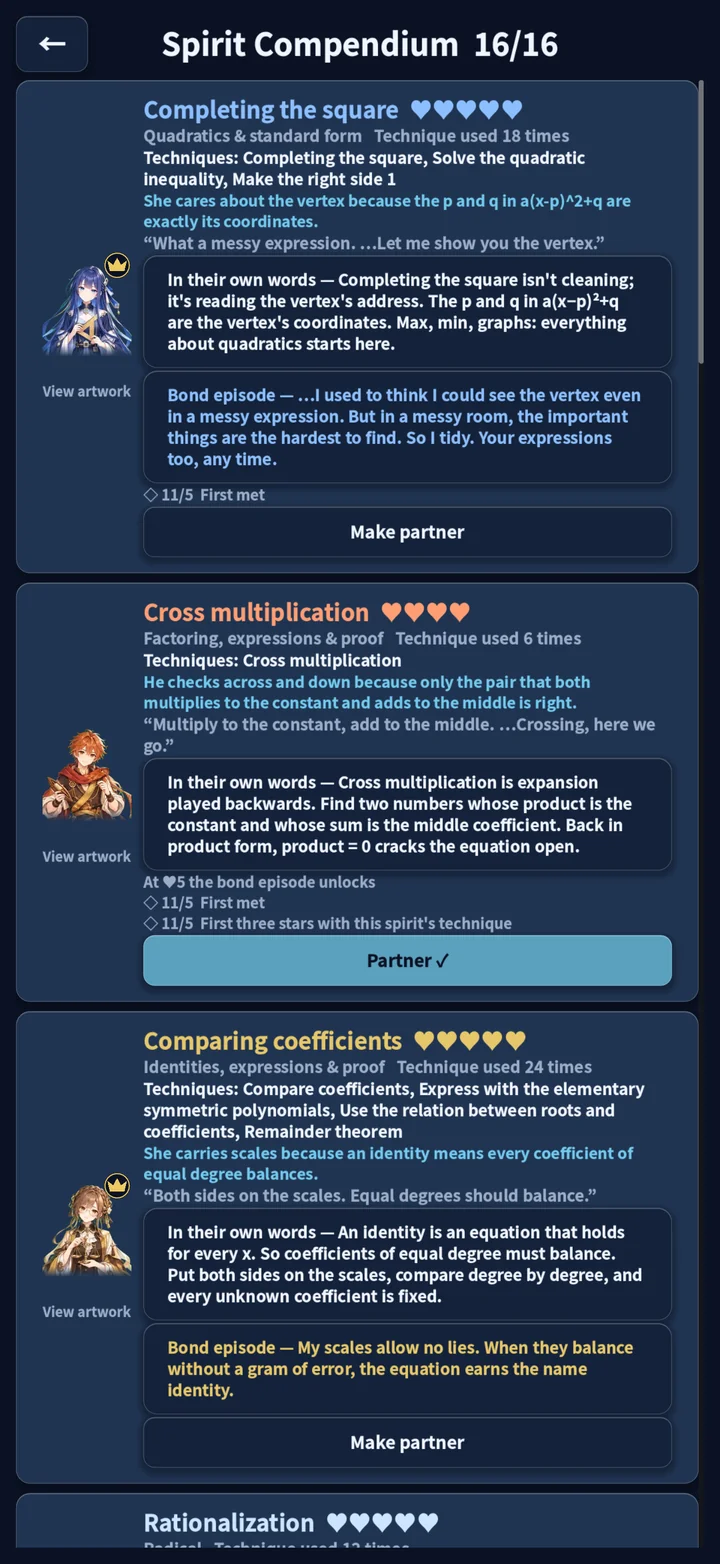
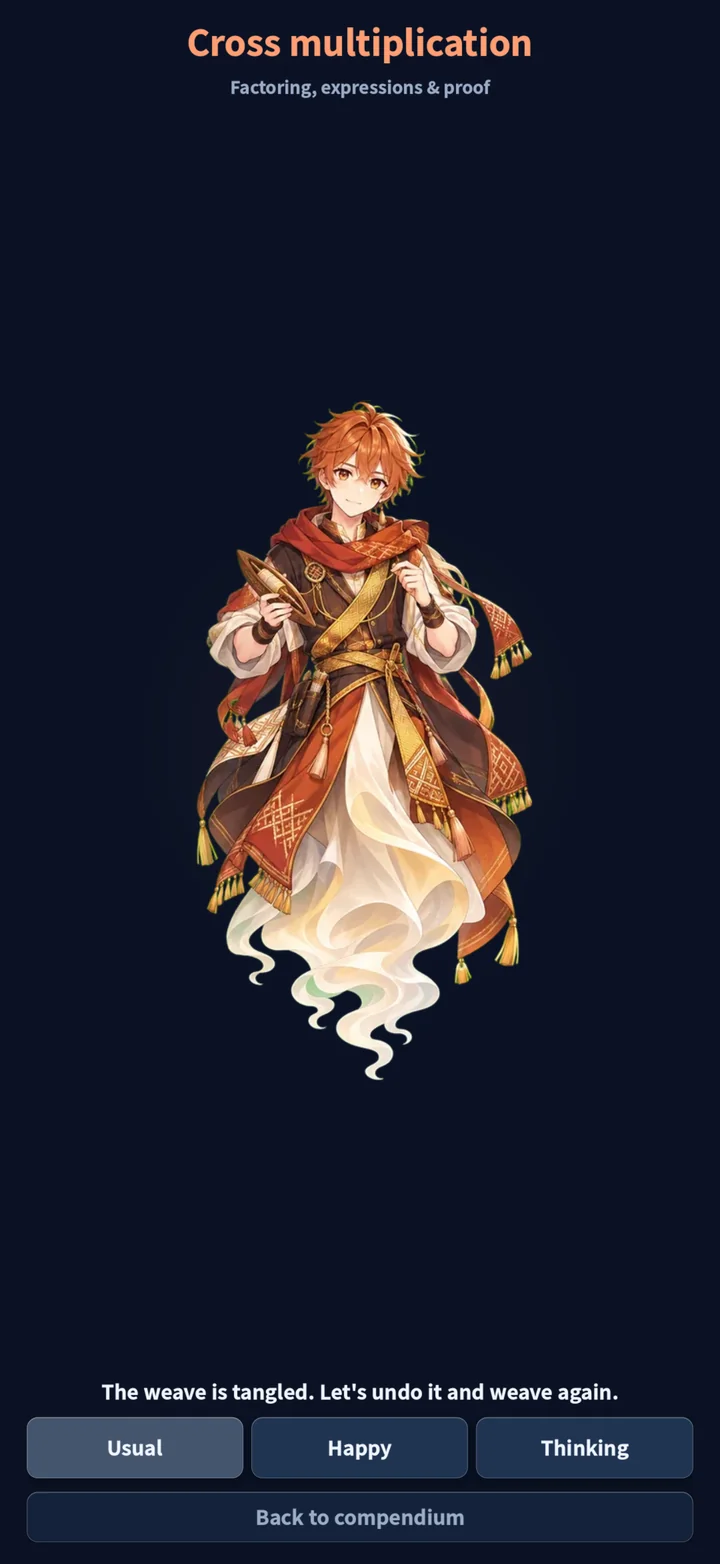
Cross-factoring is a weaver of crossed sashes. Completing the Square is a perfectionist who tidies away the vertex. Differentiation and Integration are siblings because the fundamental theorem of calculus says so. Case Analysis wears two colors because the board splits in two. There are 16 spirits, plus your guide Shiori. You meet each one on the first stage you clear with them, and all of them have full-body art and three expressions.
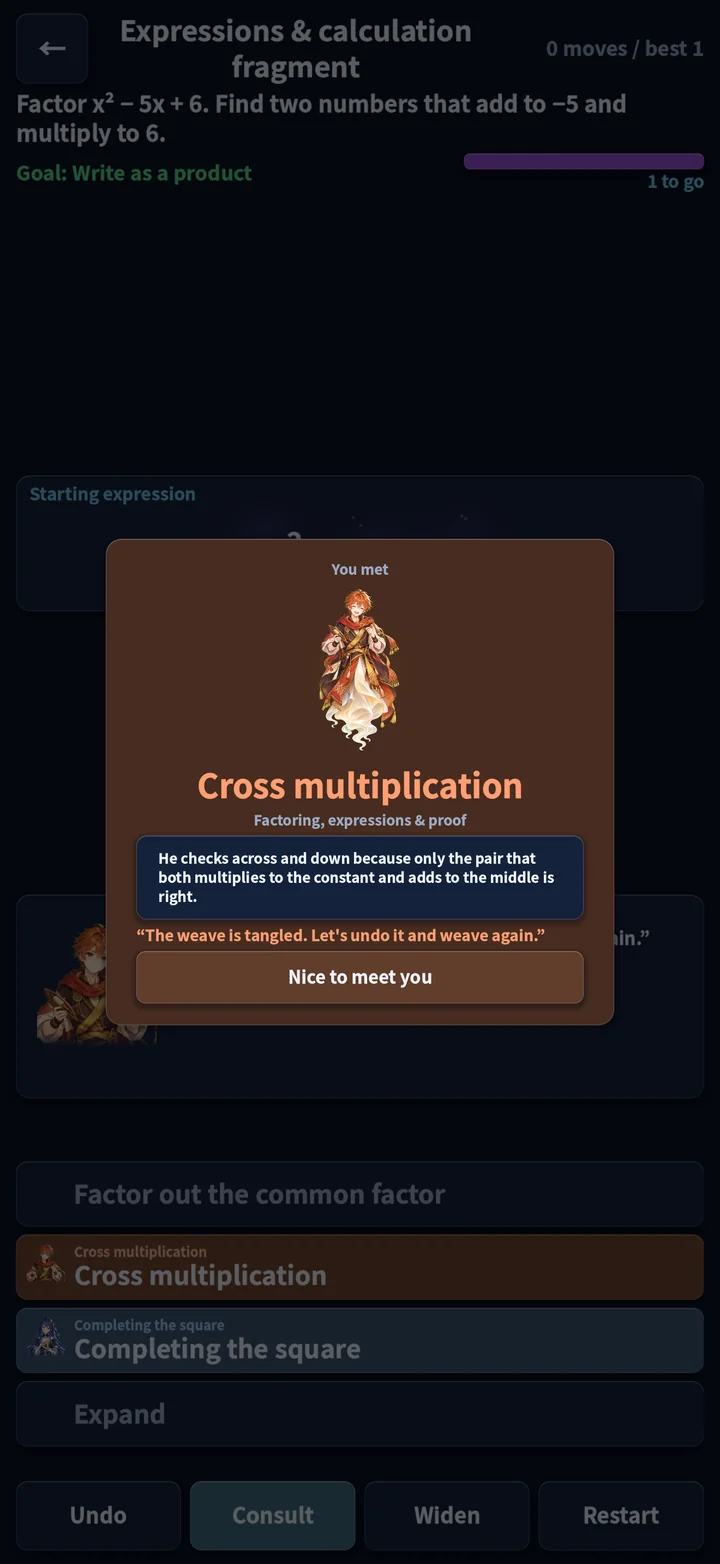
Each time you fill in a problem by your own hand, that spirit's affection rises (♥1–5). At ♥2 they gain new lines, at ♥3 their own explanation of the technique joins the Spirit Compendium, and at ♥5 a bond episode opens. Only words, explanations and stories grow: no technique is ever locked away from you. Your favorite's page doubles as a reference for that topic. The day you met and the day you first earned three stars with their technique stay in the Compendium as dated memories.
The game re-solves the board after every move and shows the remaining steps as the HP of the noise, a dark fog. A good move floats "−1"; a detour floats "+1" and the fog comes back. Press Hint when you're stuck and it solves again from where you are to show the next move. Hints and undo are unlimited. Trial and error is never punished, and your stars depend only on your final move count. Still unsure? Ask the spirit, who will tell you how to spot where their technique applies, not the answer.
Every unit has an introductory, an applied and a challenge stage. Twenty kinds of devices: gates at the zeros of a curve, rods with square-root lengths, probability branches you open and count, gears, waves, tangent lines, integral channels and more. Challenge stages add a resource budget, and some add obstacles and a required order.
To be clear about what this is: each unit covers representative topics. It is not a complete collection of every exam question type. Think of it as a way to get a hands-on feel for what equations mean.
The only limit is the number of stages and problems. Worked examples, asking spirits, the Compendium and affection all work in the free version.
For anyone who has memorized the formulas but can't tell when to use them, or who wants a hands-on feel for what equations mean. Don't choose an answer: operate the machine and observe.
 SNAPLACE