Hunt down angles and areas with numbers.
A learning game devoted to just two things in geometry: angles and areas. 65 stages run from elementary-school math puzzles to high-school trigonometry, vectors and integrals, with three map-based stories for different ages. Every problem is generated on the spot, so there are no answers to memorize.
The game is available today in Japanese only. The English edition is on its way. See the Japanese page
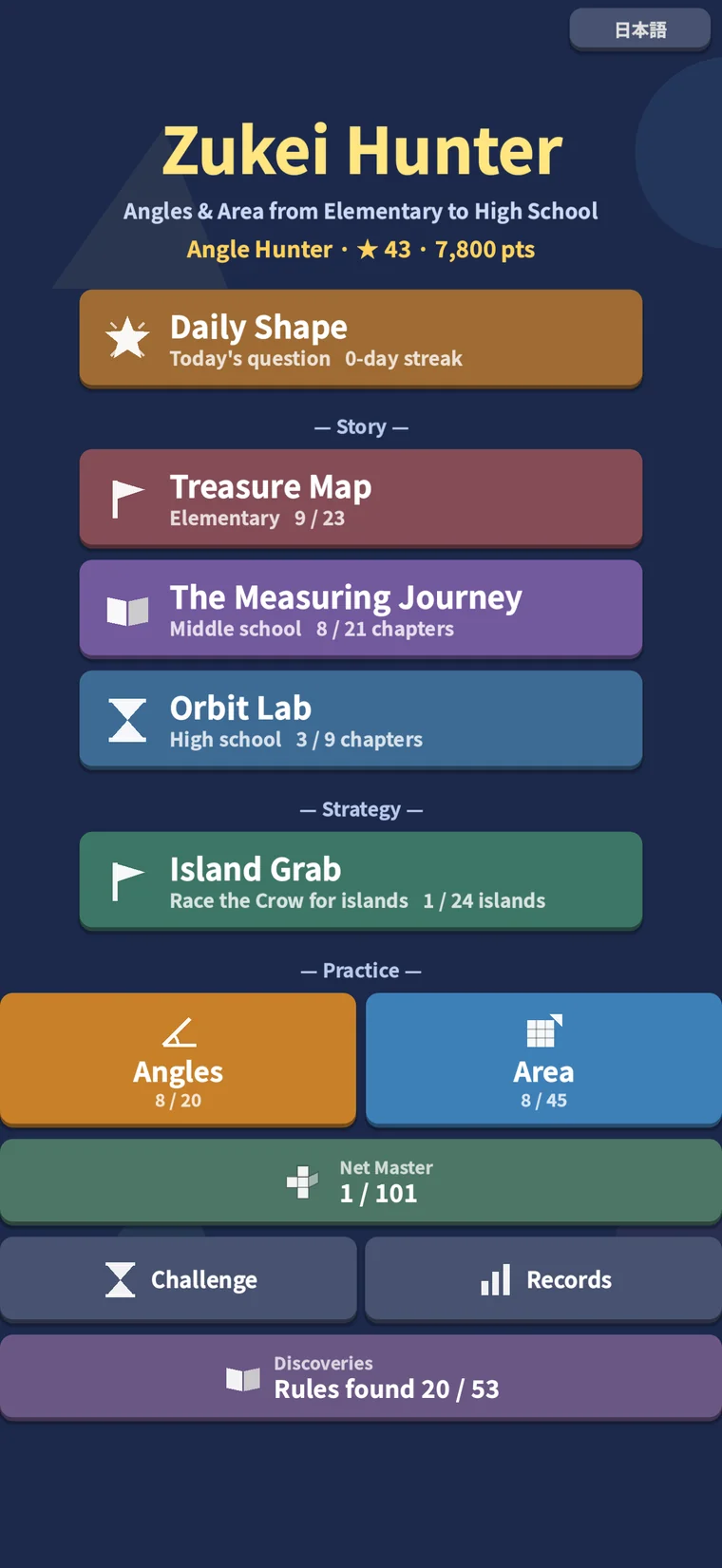
Every problem is created by the program on the spot. Even a single type, like the angle between clock hands, comes with a new time and a new answer each round. Counting only distinct problem-and-answer pairs, that's 30,763 variations, so a second pass is as useful as the first. Each stage has 2 to 6 solving methods, about 245 in all, and in challenge mode the method itself changes with every question.
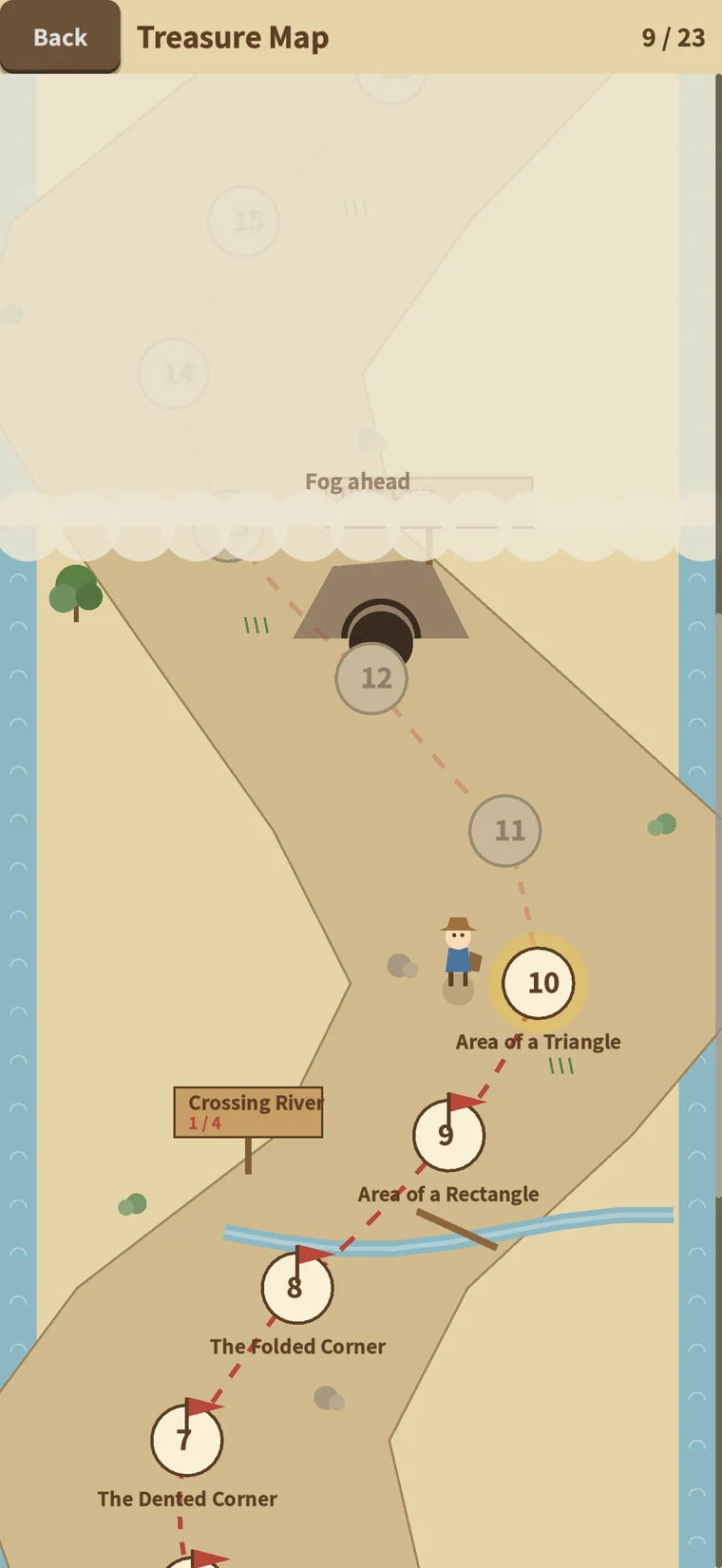
Instead of ticking off a list of units from the top, you cross a single map step by step. Each clear plants a flag, the fog ahead lifts, and the road grows. You can see how far you've come in the shape of the map itself.
Treasure Map
23 steps
Beach, forest, river, cave, mountain, valley: head for the treasure chest at the very end. Each step is something to find out with your finger. Tear the corners off a triangle and line them up straight; roll a circle and count three diameters and a little more. You test it by hand before you ever read a formula.
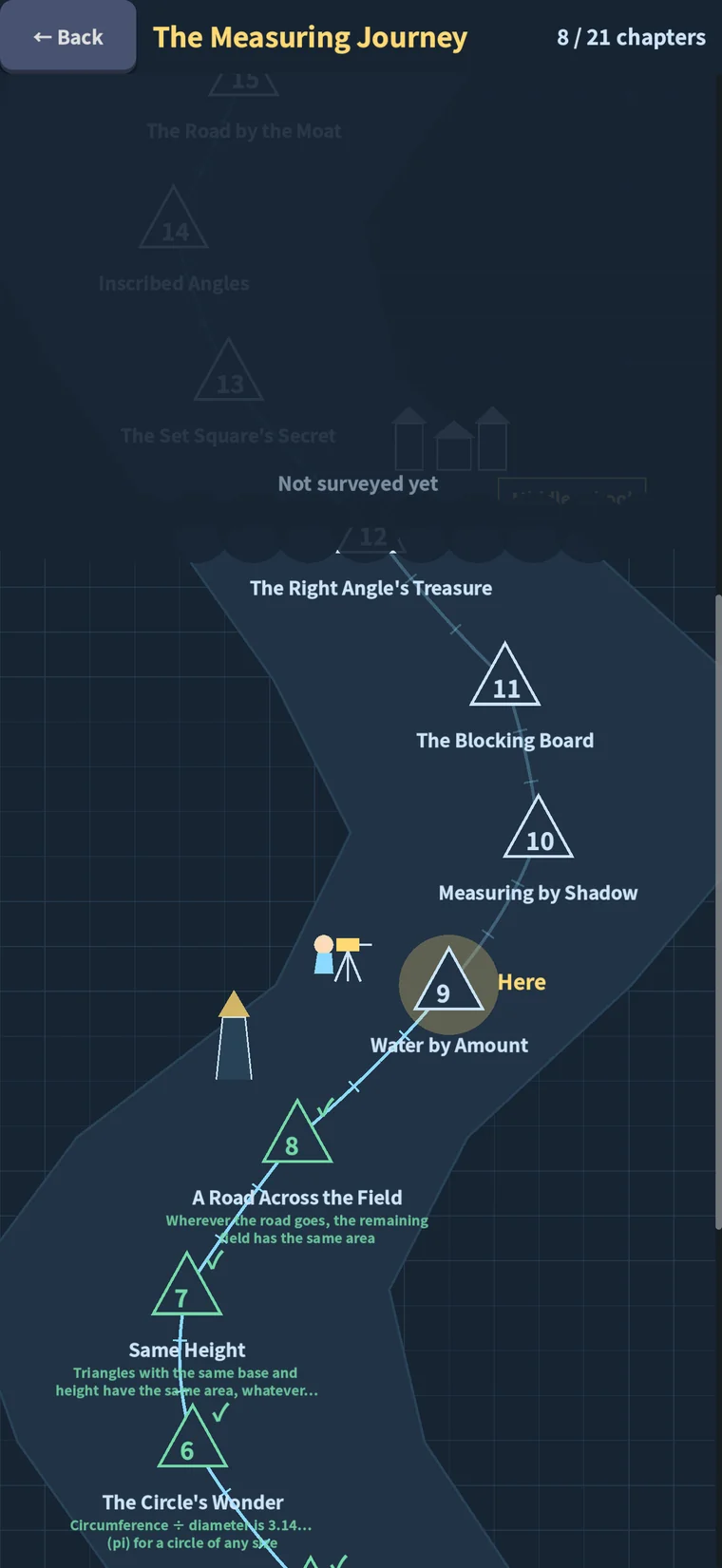
The Measuring Road
21 chapters
The chapter menu is a surveyor's road map. Follow the survey points across the country, past towns, bridges and towers. A wandering scholar keeps getting there first and selling formulas at a high price, and the only way to find out if they're telling the truth is to measure it yourself.
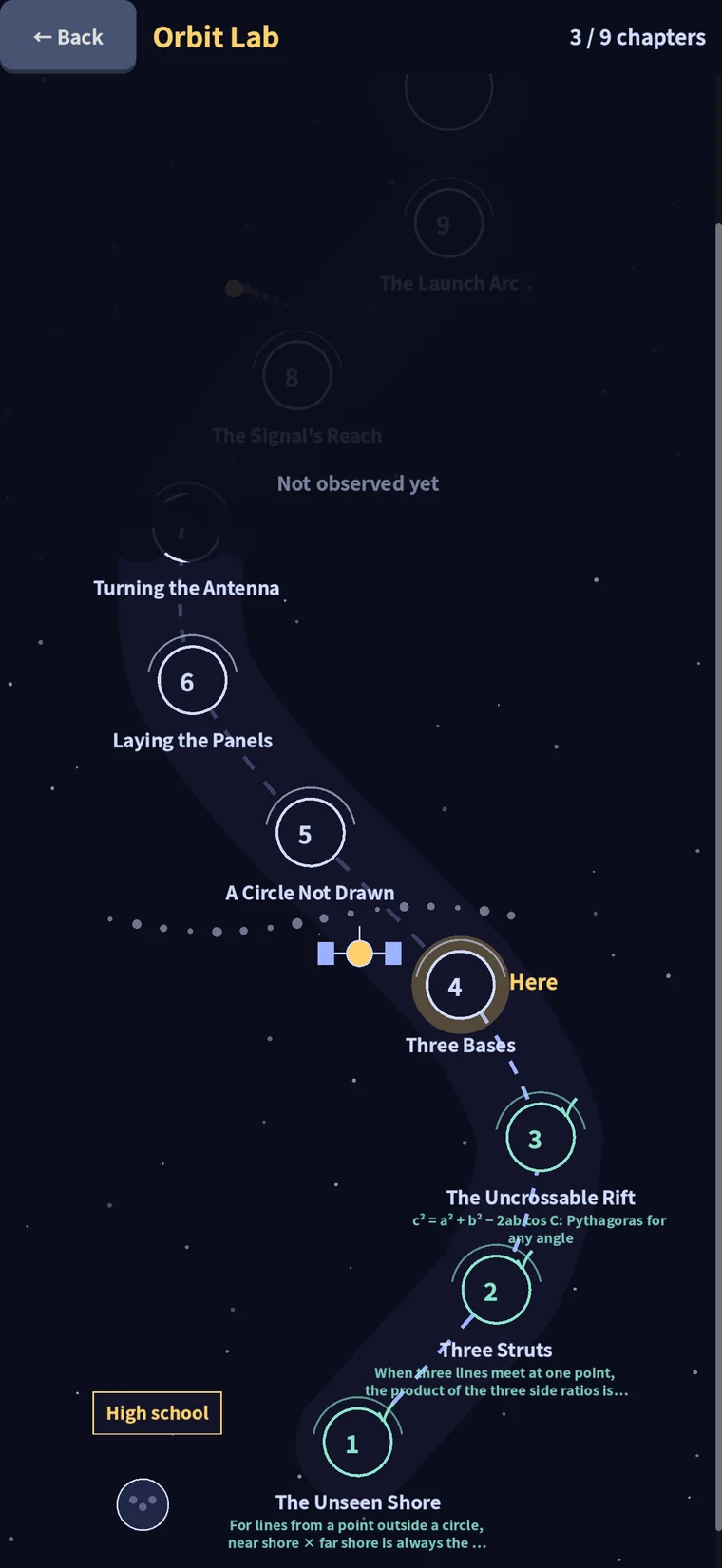
Orbit Room
9 chapters
This one is a star chart. Fly a probe from planet to planet, linking orbits until you reach a distant star. Landing sites, relay towers, signal range and launch paths are all decided by math alone: power of a point, the laws of cosines and sines, radians, the equation of a circle and integrals become real tools.
In the middle- and high-school stories, you answer with the same calculator as the main game, not by choosing. These are questions you can't answer without calculating, and you can type the whole expression and press "= Calculate".
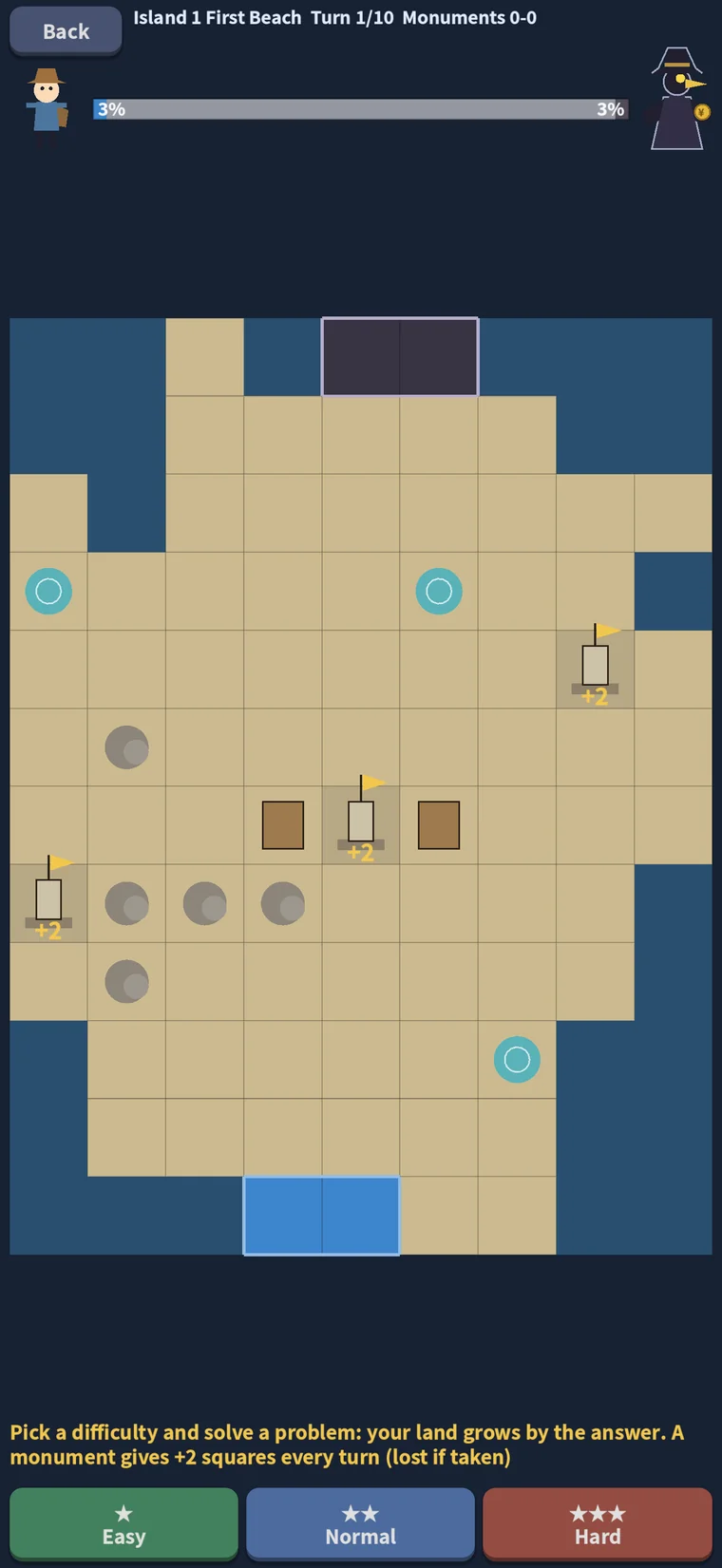
A territory game against a crow. Pick your difficulty and solve a problem, and you expand your land according to the number you got right. The crow's monument grows 2 squares every turn, and land it takes never comes back. Who holds more after 10 turns?
You choose Easy, Normal or Hard yourself. Harder problems claim more at once, but miss and you don't advance that turn, so where to take a risk is the whole strategy. There are 24 islands, sorted by level.
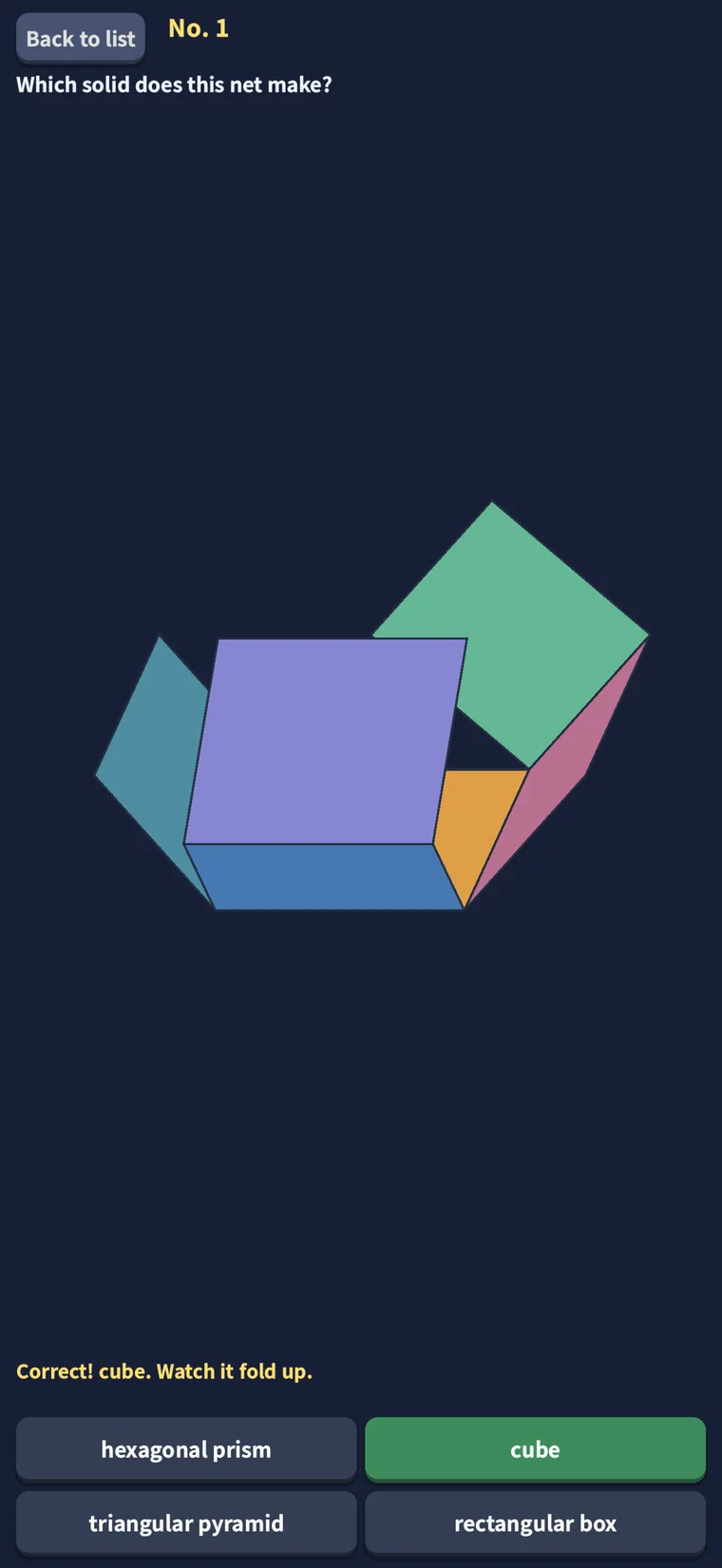
"Which solid does this net make?" That's the question in this mode. Right or wrong, you see the net rise up and fold into its solid on the spot. A wrong answer is exactly when it's most worth watching, so it isn't saved for correct ones.
Cube, cuboid, triangular, square, pentagonal and hexagonal prisms and pyramids, regular tetrahedron, regular octahedron, cylinder and cone. One solid can unfold in many ways: the cube alone has 11.
Two 10-question runs. Challenge 10 draws ten at random from the 101 nets, alternating "which solid is this net?" with "which net makes this solid?" Applied 10 climbs through number problems connected to nets, from the faces of a die up to the shortest path around the side of a cone.
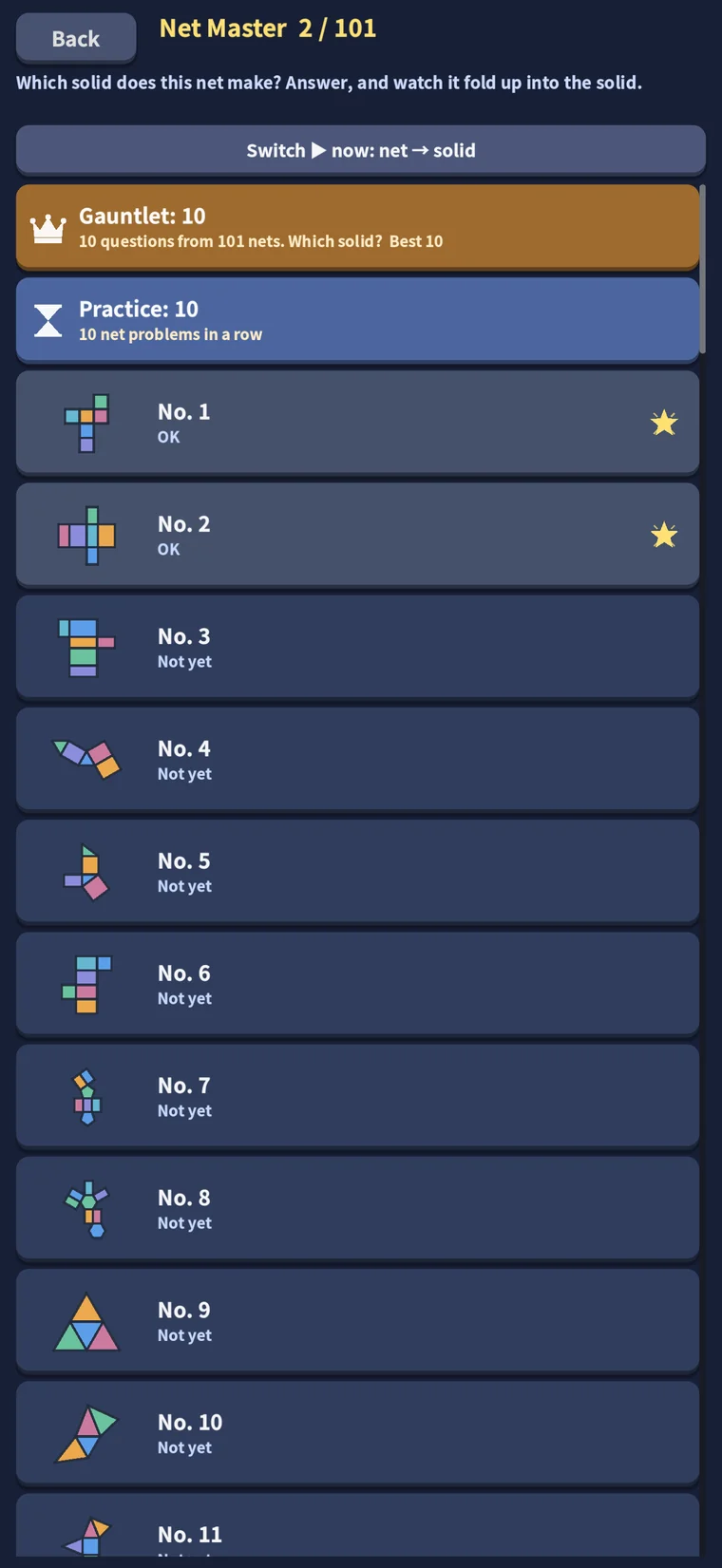
Each course runs in order from elementary to middle to high-school level. Clear a stage to open the next.
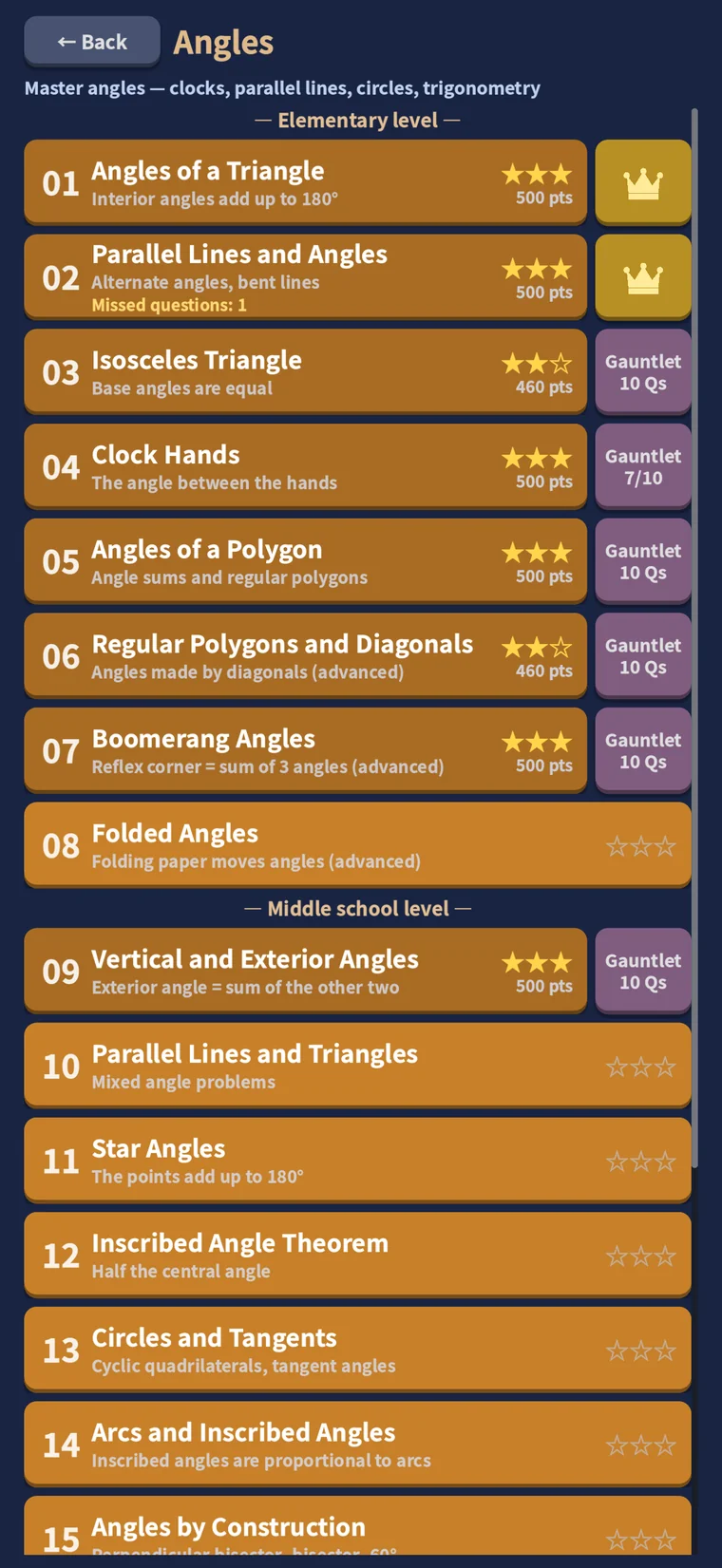
Angles
20 stages
Angles of triangles, parallel lines, clock hands, regular polygons and diagonals, boomerang shapes, folding, star shapes, the inscribed angle theorem, circles and tangents, arc ratios, triangle centers, trigonometric equations, angles between vectors, angles in space.
Areas
45 stages
Areas of triangles, paths, points inside rectangles, leaf shapes, volume and surface area, water tanks and levels, cross-sections of solids, the Pythagorean theorem, similarity and volume ratios, lunes of Hippocrates, power of a point, Ceva and Menelaus, the law of cosines, Heron's formula, radians, the equation of a circle, the one-sixth formula, solids of revolution.
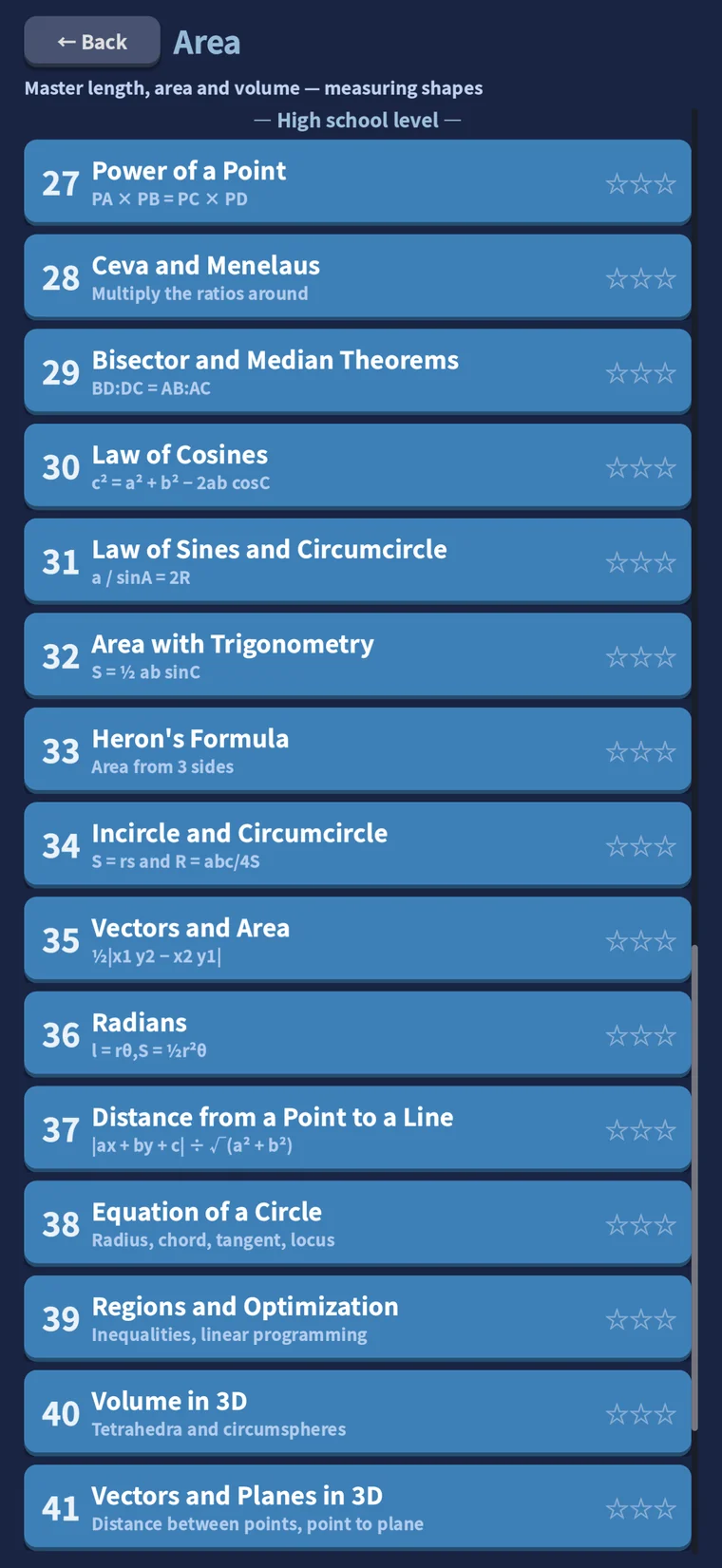
In the younger players' story, questions are short and hands come first: tear the corners off a triangle with your finger and line them up straight, then put what you found into words.
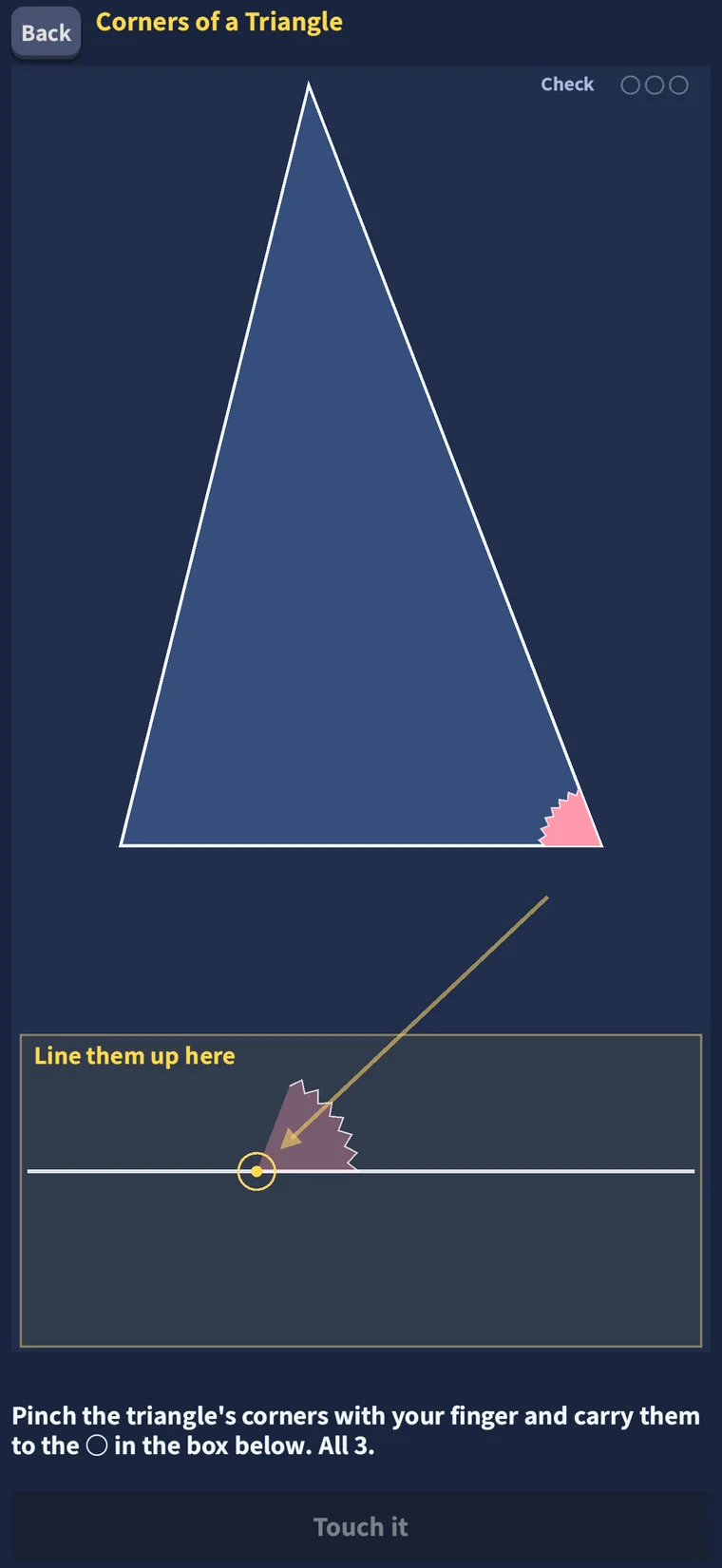
Each tap moves the solution forward one step. An auxiliary line slides into place, the key part lights up, equal angles get marked. Signature problems like clock hands, boomerang shapes, folding, leaf shapes and the lunes of Hippocrates have their own animated explanations. You still enter the final calculation yourself.
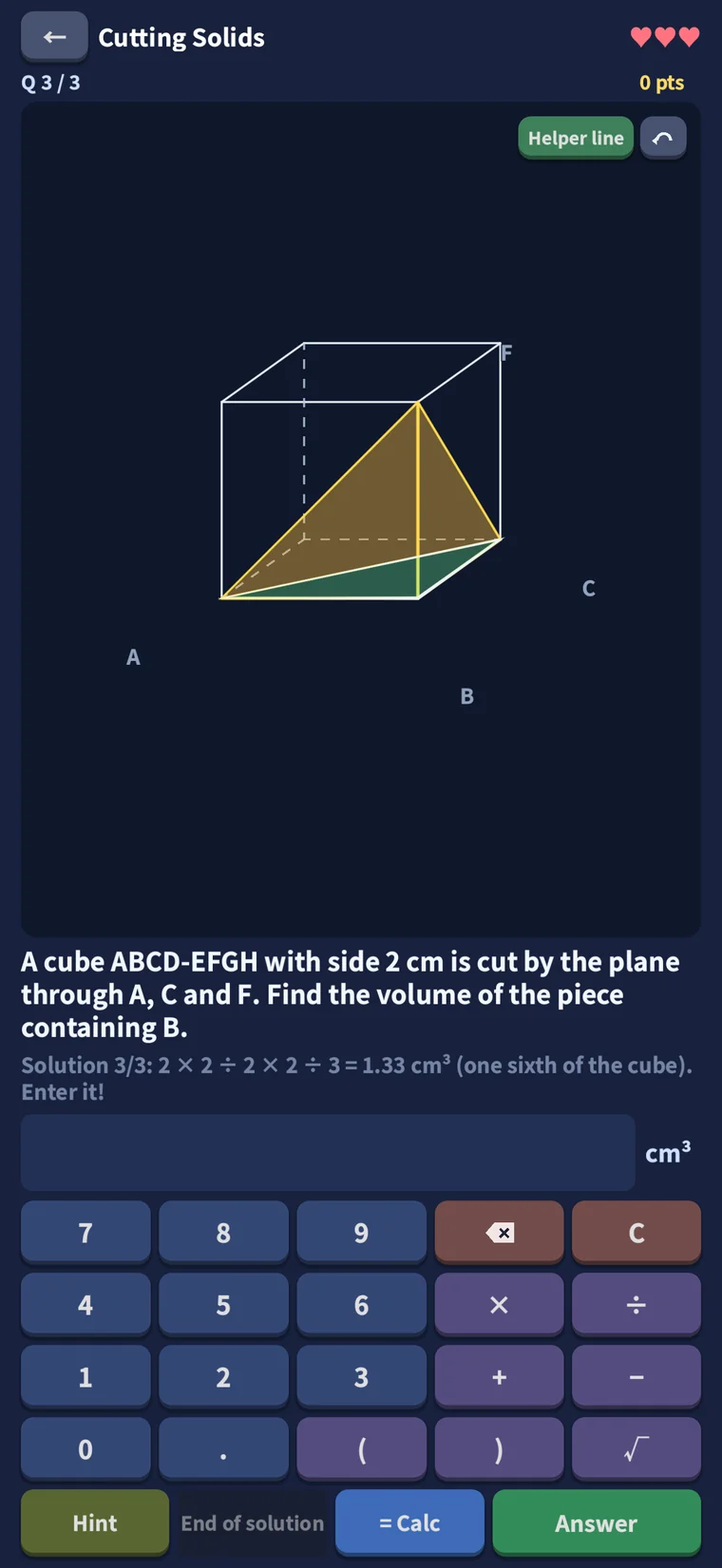
The answer field takes expressions as well as numbers (× ÷ + − ( ) √). Type "12×8÷2", or "√(13×13−5×5)" for the Pythagorean theorem, and it's graded as written. A malformed expression is pointed out without costing you a heart. All modes and all three stories use the same calculator.
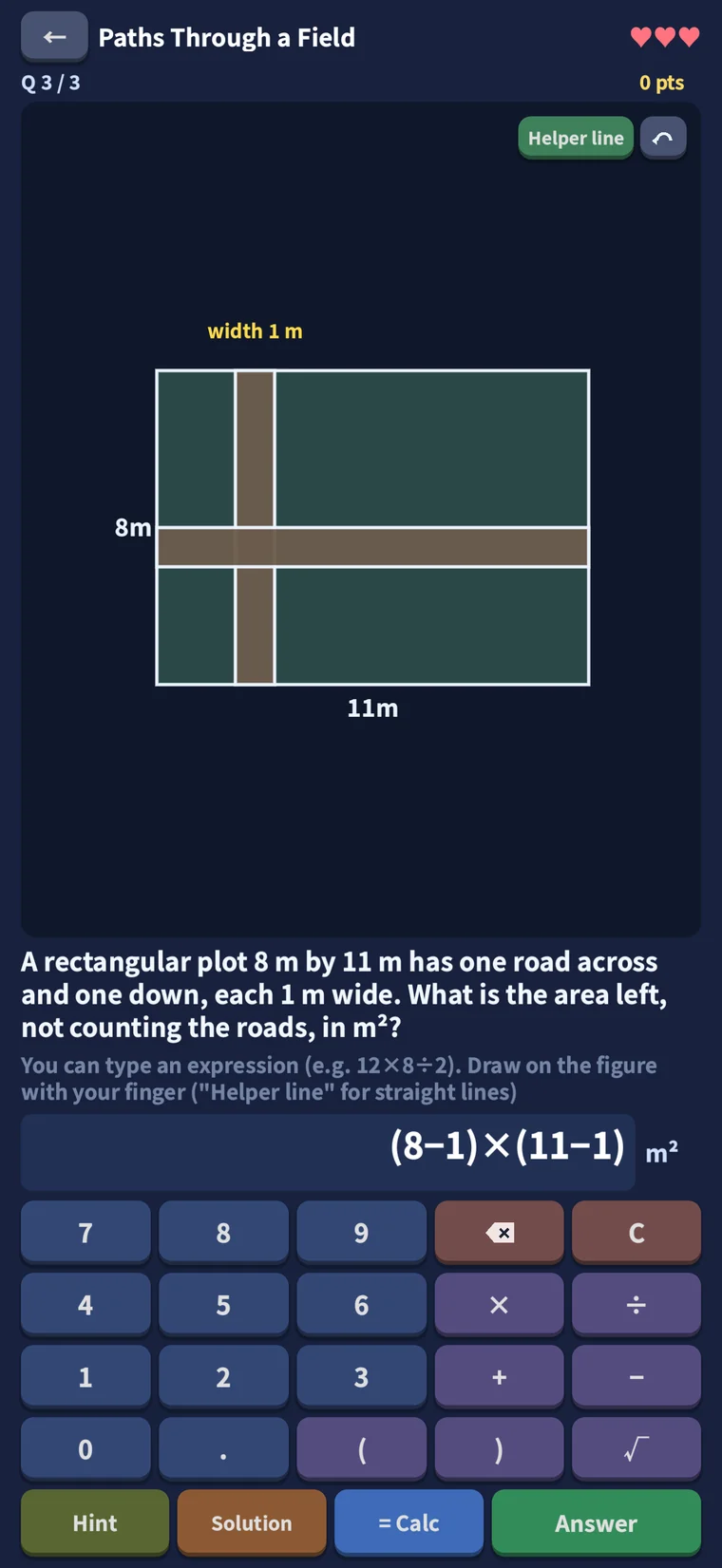
Tap the ✏ at the top right of a figure to draw auxiliary lines by tracing. Endpoints snap to vertices, midpoints and circle centers, so a parallel through a bend or a line from vertex to midpoint comes out exactly as you meant. Tap ↩ to remove them one at a time.
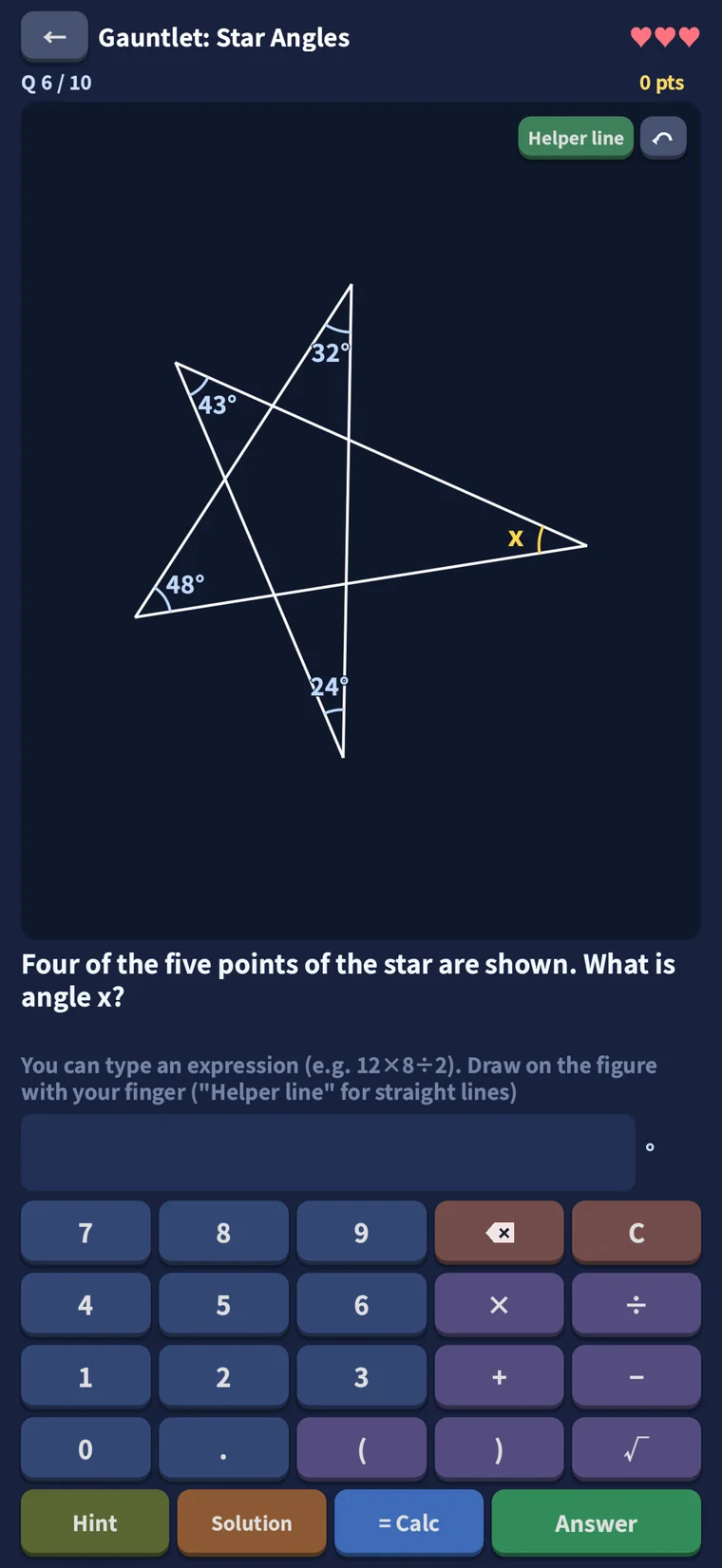
Hearts left at the end become 1 to 3 stars. Cleared units open a 10-question challenge, and finishing it earns a crown. Your total score raises your rank through six levels, from Apprentice up to Shape Sage, and your personal bests in time attack and survival stay on record.
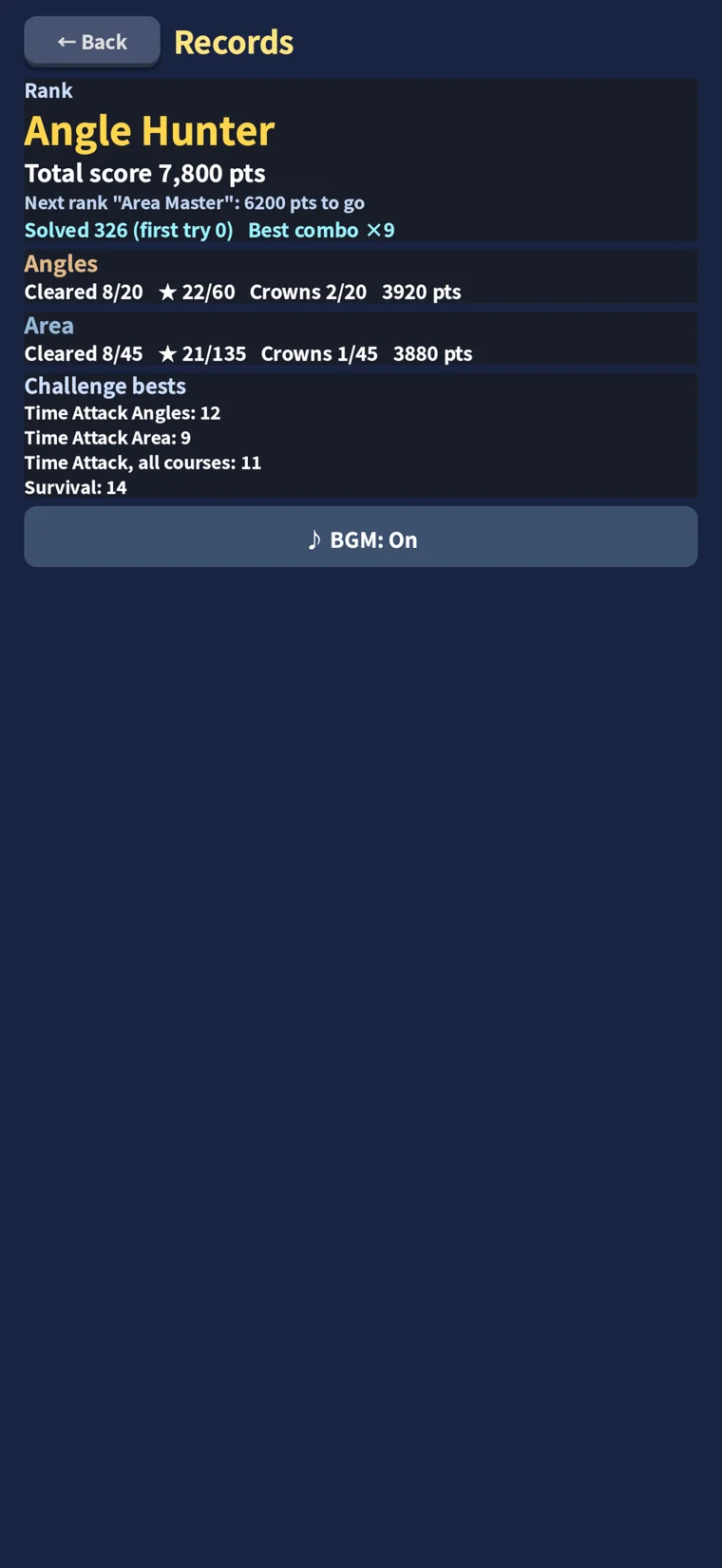
Not just right or wrong. Which try you got it on, whether you used a hint, how fast you were and whether you're on a streak all multiply together.
| First try | ×2.0 (second try ×1.4, third try ×1.0) |
|---|---|
| Hints | ×0.7 each time you look (two stages: "the idea", then "nearly the formula") |
| Speed | Under 15 s ×1.3, under 30 s ×1.15 |
| Combo | +0.1 for each correct answer (up to ×2.0). A miss resets it |
In challenge mode, ten questions climb a ladder of difficulty. In "parallel lines and angles", for example: alternate angles, co-interior angles, bent lines, zigzags, then zigzags in reverse. The solving method itself changes with every question.
The only limit is how much content you get. Calculator, solution animations, auxiliary lines, hints, stars, ranks and records all work in the free version.
From elementary math puzzles to high-school trigonometry, vectors and integrals, in one app that keeps going as you grow. Watch the solution animate, draw your own lines, answer with the expression as you wrote it. The path to solving it is right there in the game.
 SNAPLACE