A world where gravity has doubled and the moon is falling. A harbor whose bridge washed away, so the cargo has to be thrown across. Work out what broke, test it by experiment, and build the formula yourself to fix it — high-school physics is the only tool you get. The subject is the full high-school range, but what you actually do is repair things. Pick from four ways to play and work through 5 districts and 30 machines, a 10-chapter story, 26 broken worlds and all 113 units.
Available in English for iPhone and iPad. The English edition for Android is coming soon. See the Japanese page
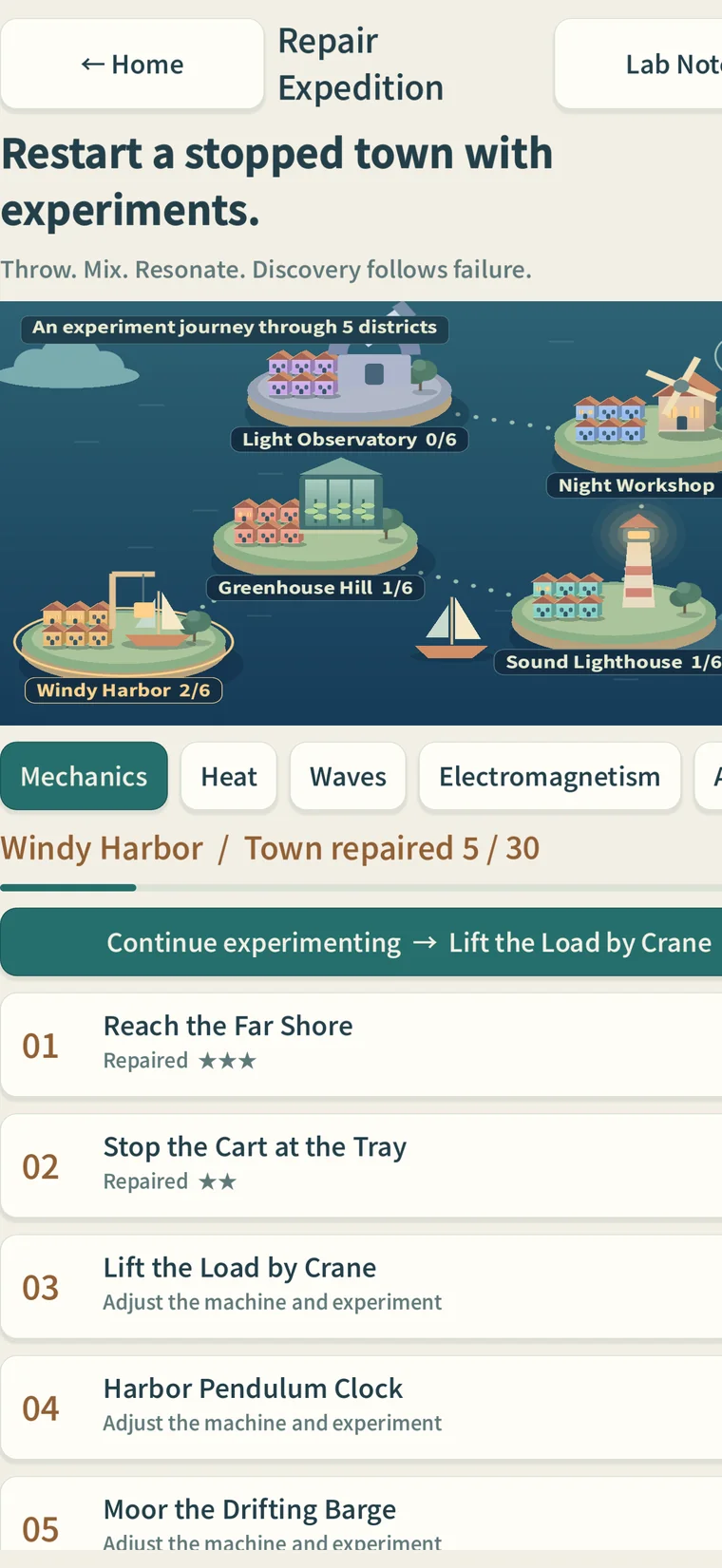
The Repair Expedition starts you in a town that has stopped working. Each of its 5 districts has 6 machines. Fix them in turn and you end up discovering that district's laws with your own hands, one at a time.
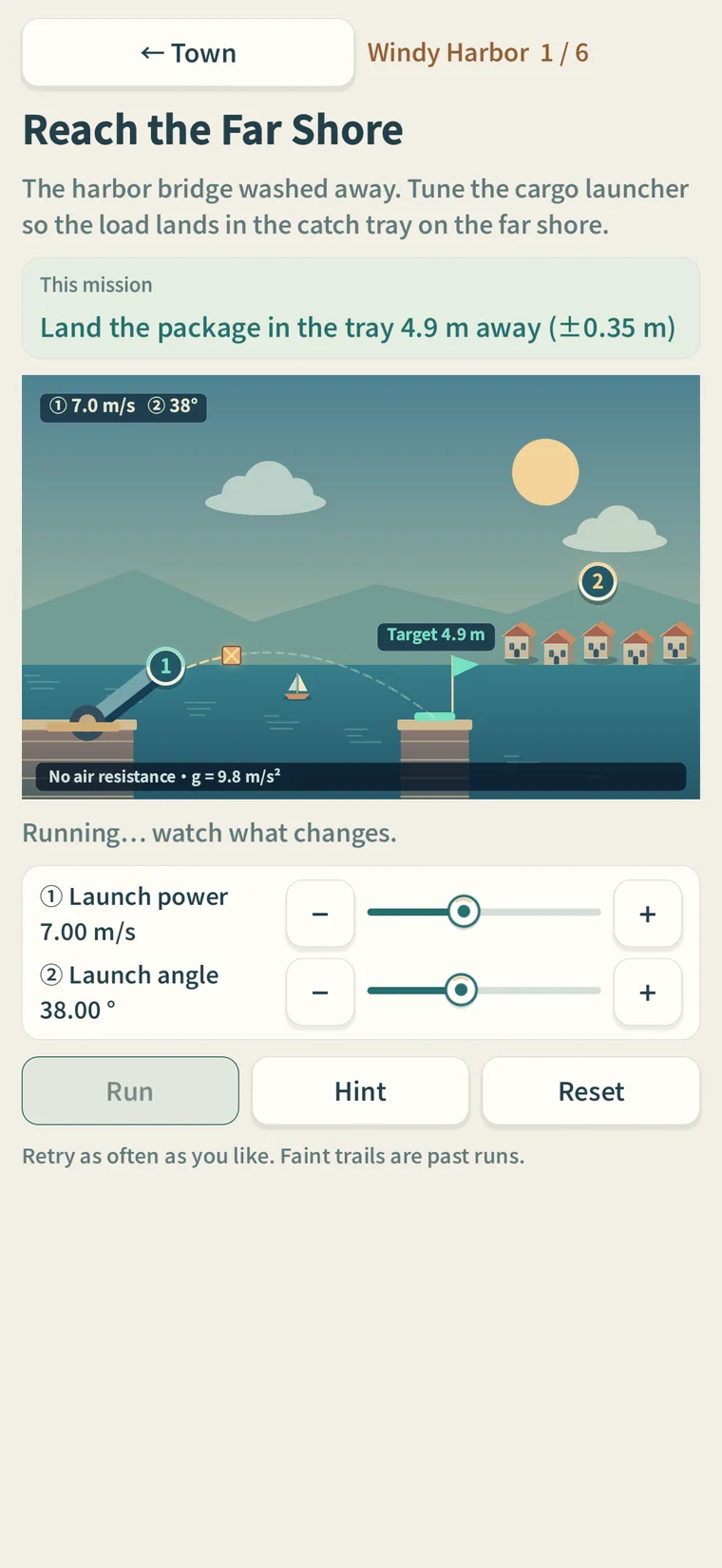
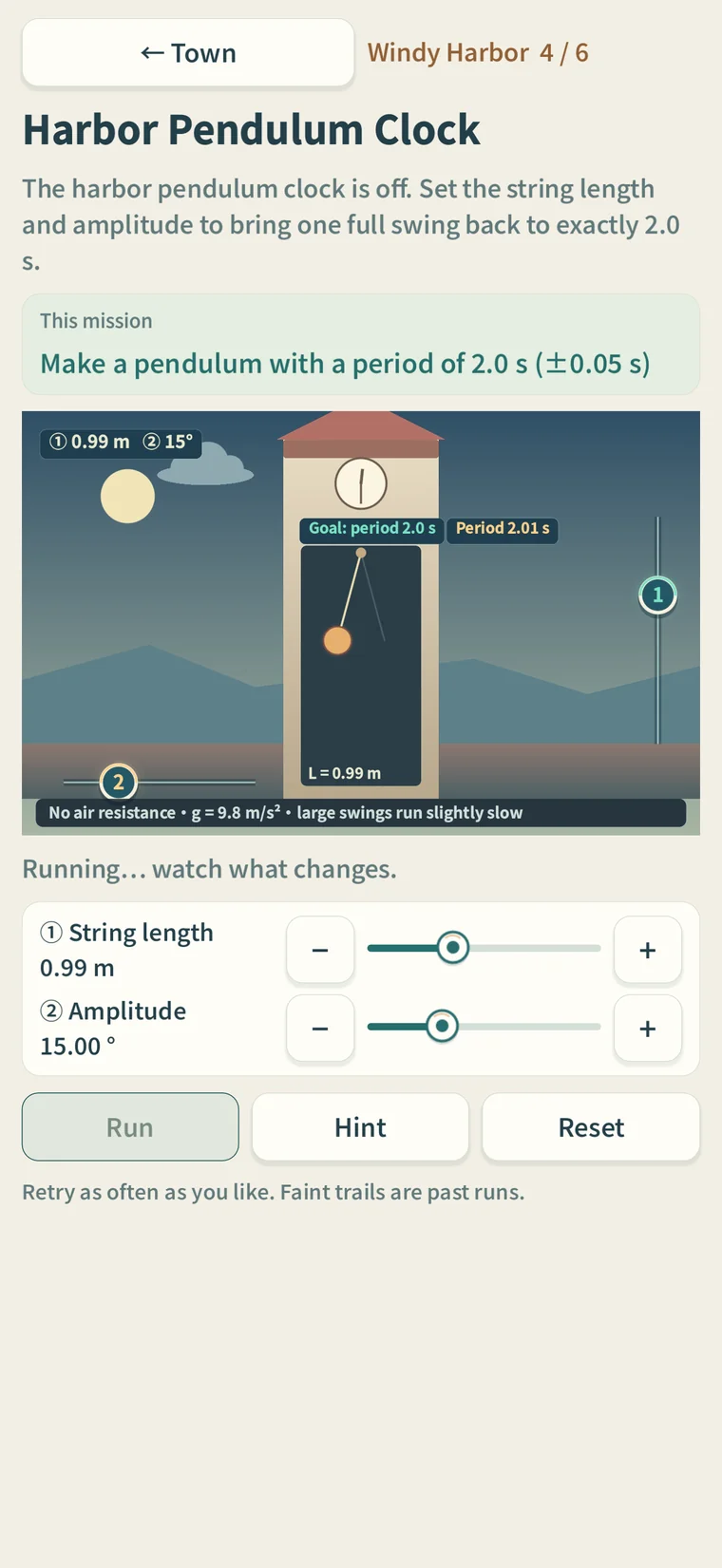
The harbor's bridge is gone, so you adjust the power and angle of a cargo launcher until the load lands in the receiver on the far shore. Too short, too long — change one thing and try again. Your lab notes keep a record, and a faint trail of the last attempt lets you compare as you close in.
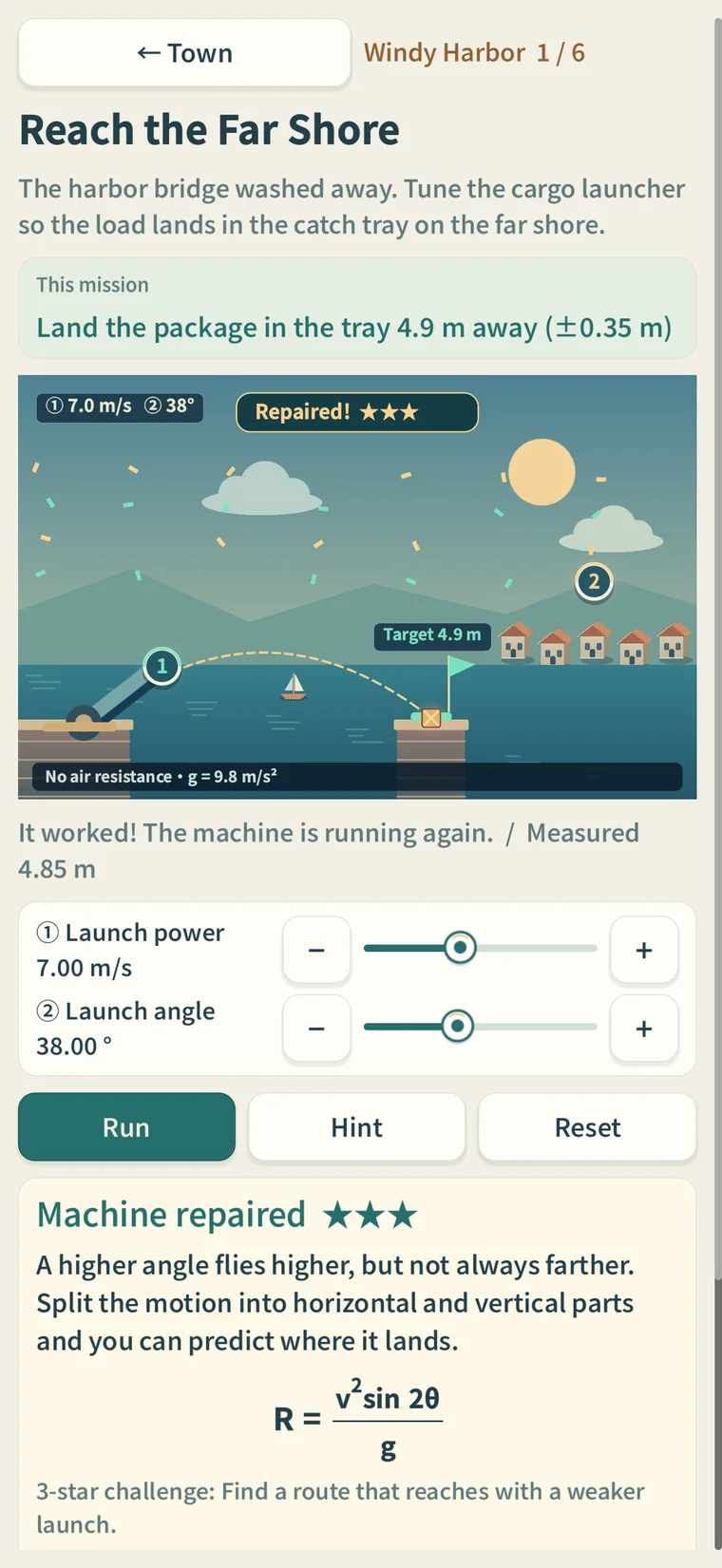
Once the repair succeeds, what was happening inside the machine is handed to you as a law, written as a formula. Because the formula comes after the working experiment, you already have a feel for why it looks the way it does.
Load the cart more heavily and it still stops in the same place. Swing the pendulum wider and its period barely moves. Ice stays at 0 °C until it has fully melted. Some dials are there precisely because they make no difference, so you can spot for yourself the quantities that cancel out of the formula.
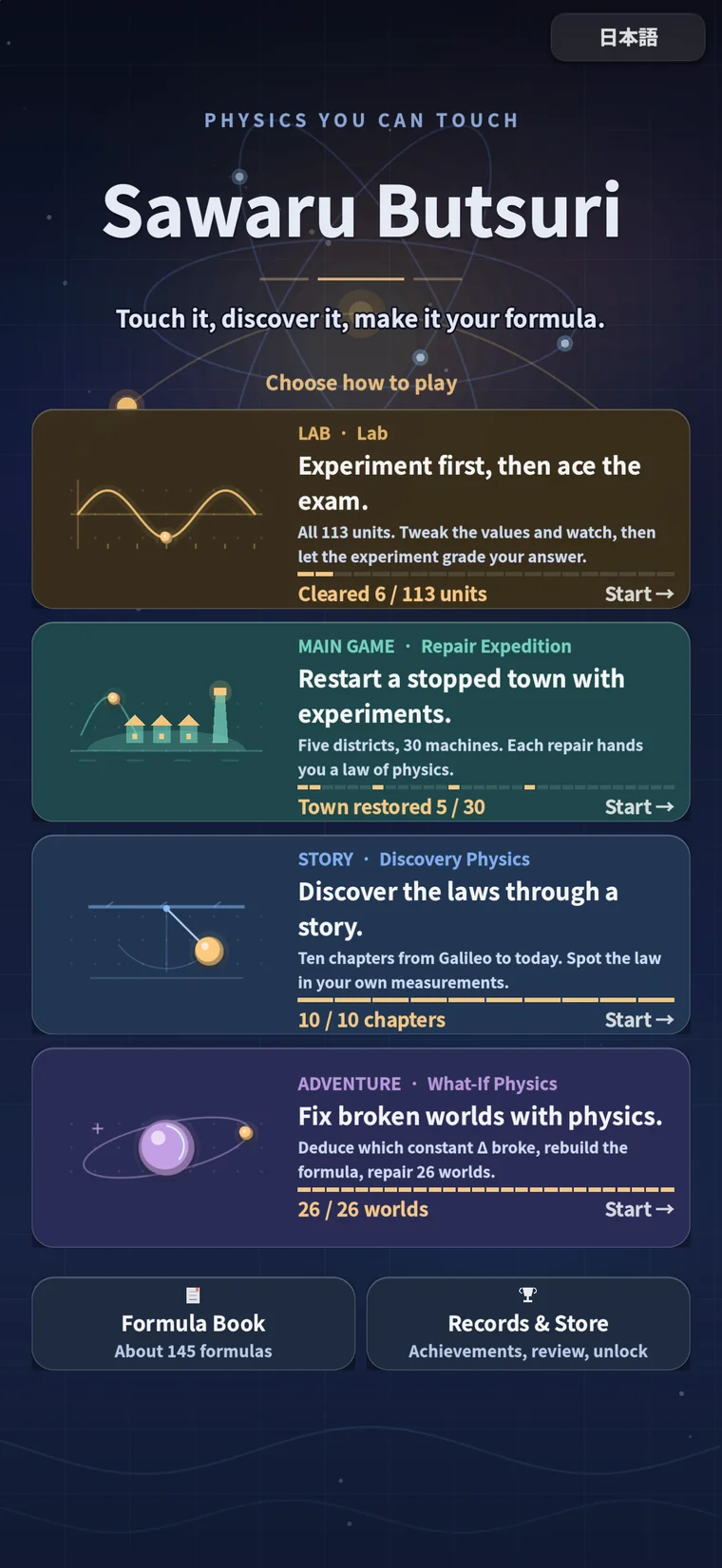
Lab, Repair Expedition, Discovery Physics and What-If Physics sit side by side on the home screen. Start anywhere and switch whenever you like. Each card shows your progress, so getting back to where you were takes one look. Below them are the Formula Book and your records.
Experiment Lab
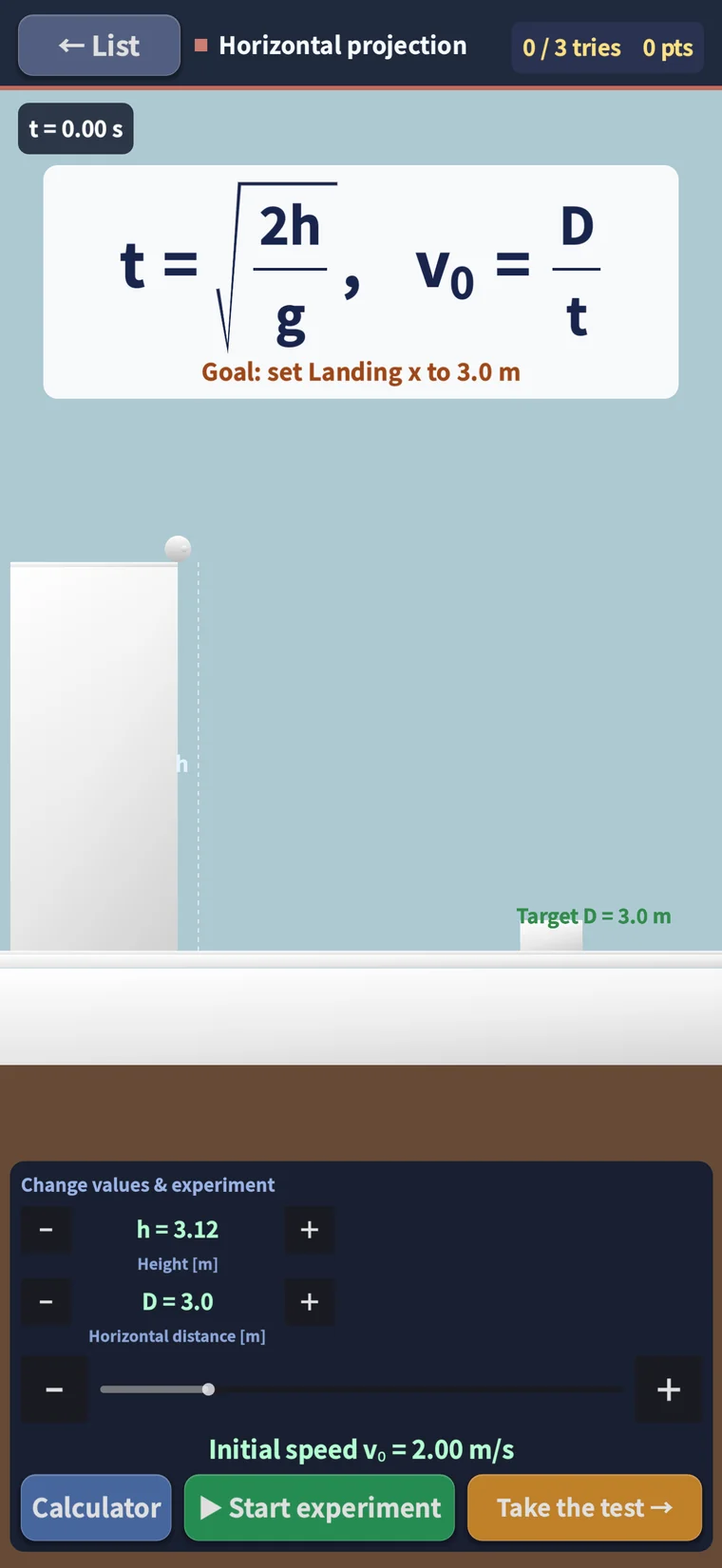
The formula to learn, front and center
The formula is displayed large while you change values and watch what happens. Each unit is a mission: calculate with the formula and hit the target exactly. Score 120 points within three tries to clear the unit and move on.
Exam Lab
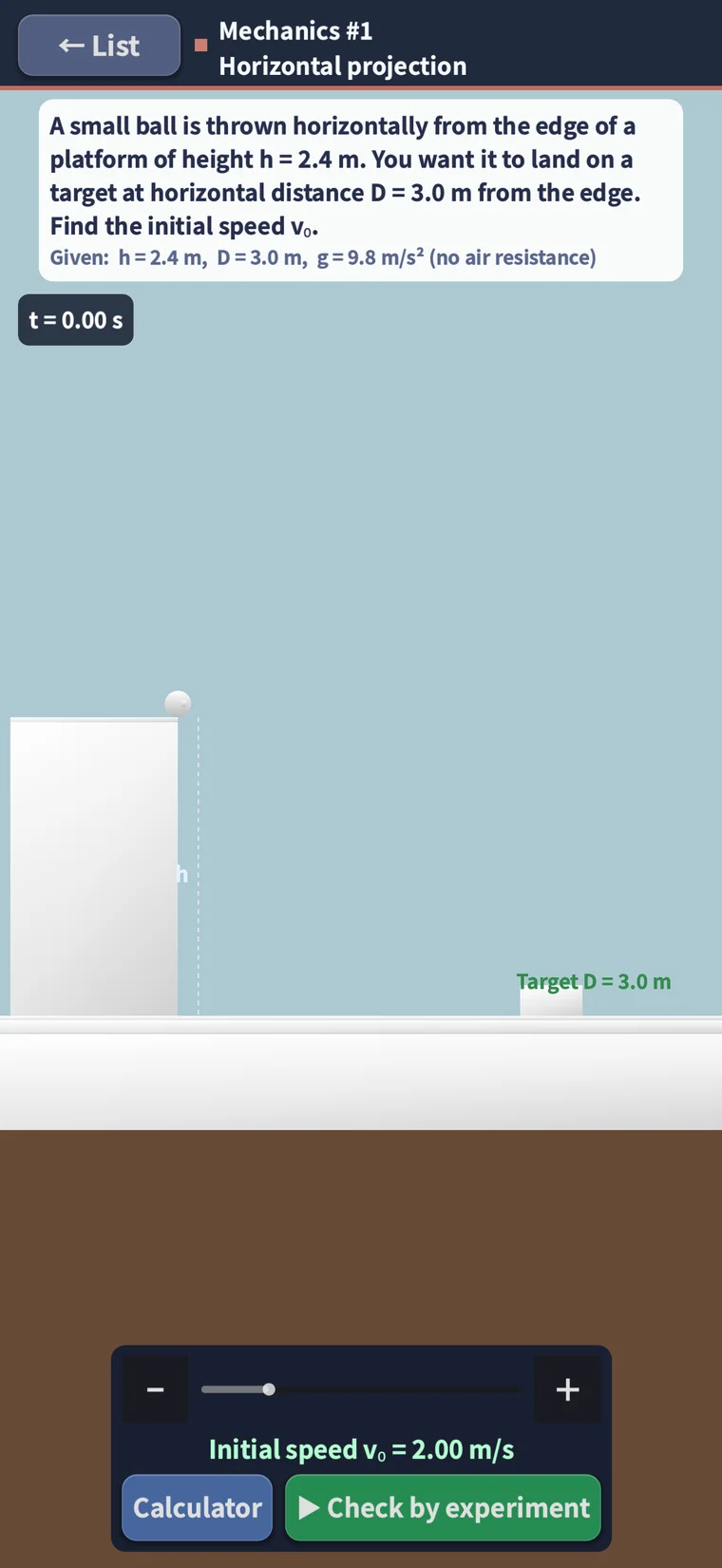
Real exam-style problems
Read an exam-style problem and enter the answer you calculated. That number becomes the experiment's parameter, and the simulation grades your work. Land dead center for a PERFECT; stay within 0.5% for a high score.
Discovery Physics
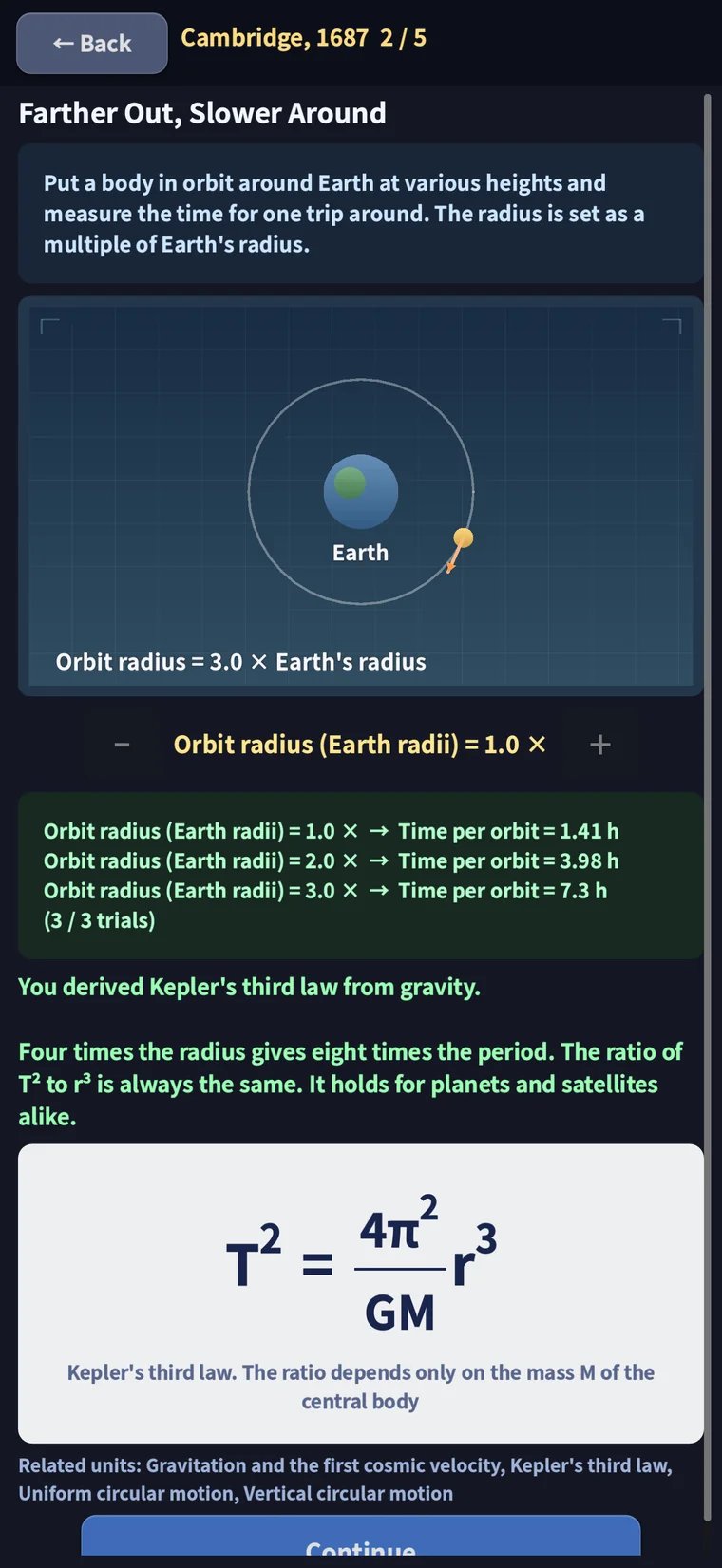
A 10-chapter story through all 113 units
Travel from Galileo's tower to the modern laboratory and relive each discovery, spotting the law in numbers you measured yourself. In Cambridge, 1687, change an orbit's radius, time its period three times, and notice that the ratio of T² to r³ never changes.
What-If Physics
26 worlds, broken and waiting for repair
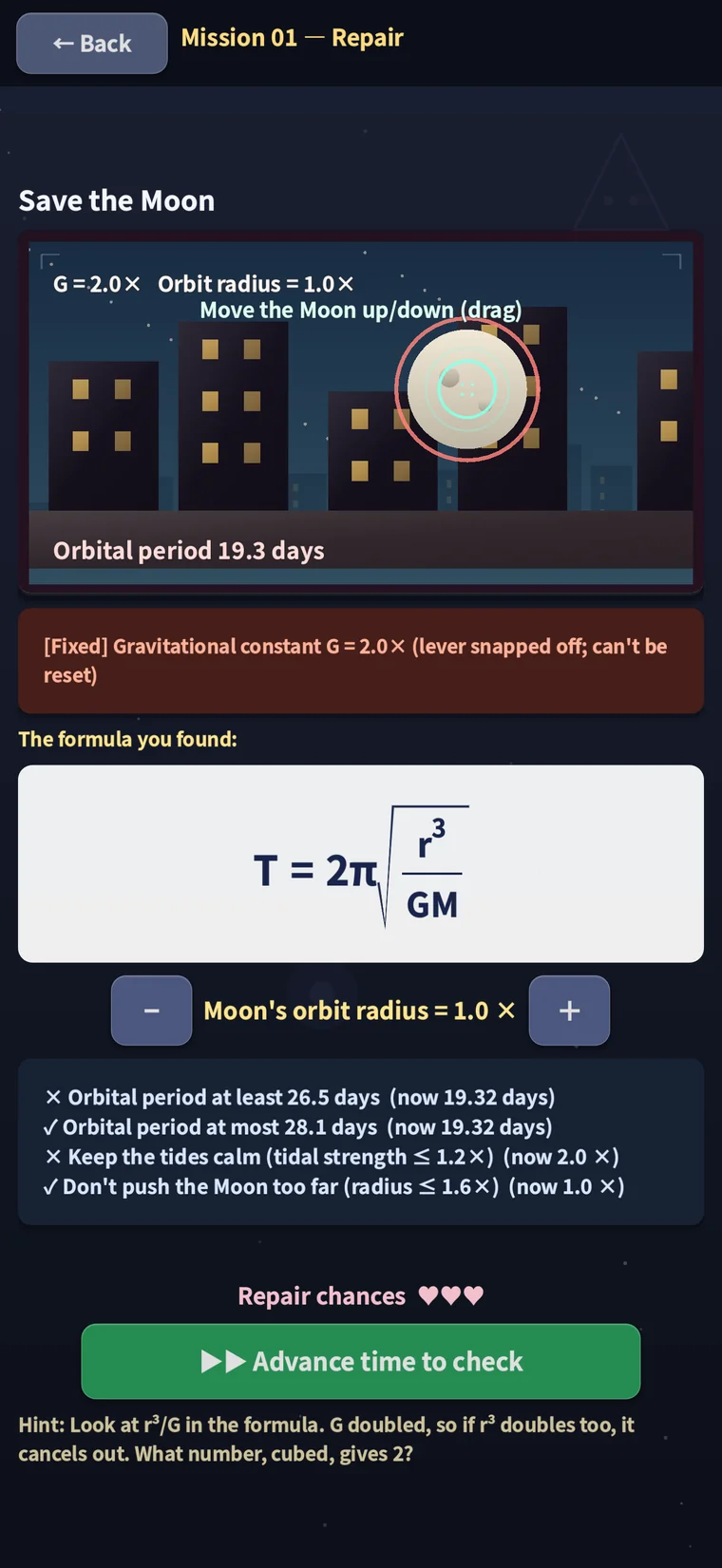
"What if gravity doubled? Would the moon fall?" Chase the mysterious Δ, who has been breaking the constants of nature, with your partner the Professor. Hear each client out, deduce the cause, assemble the formula piece by piece through experiments, and repair the world. A fill-in-the-blank check at the end means the formula is still with you when you finish.
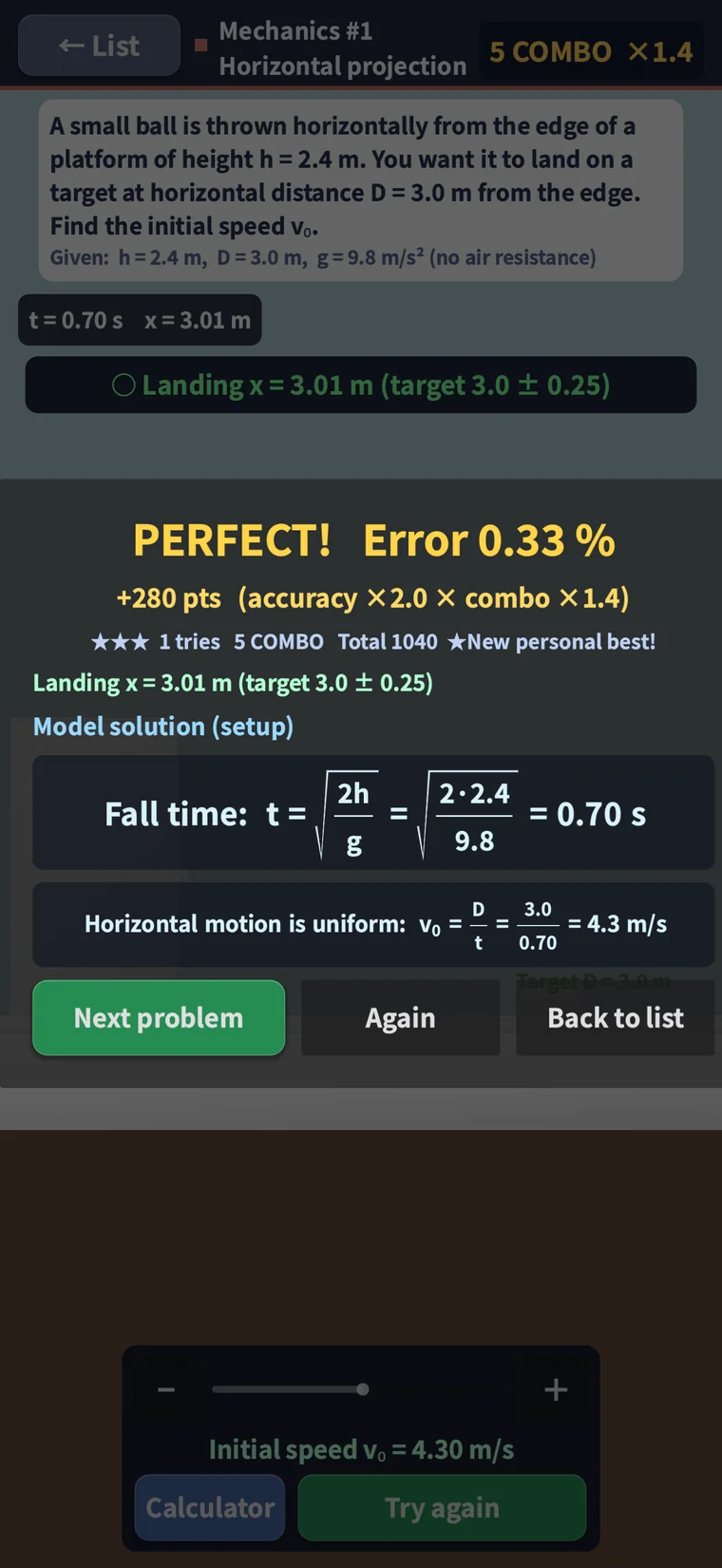
Set up the equation, enter your answer, and the simulation runs with that value. Dead center on the target is a PERFECT. Your score reflects how accurately you solved it, not whether you were roughly there, and accuracy scores and combos build up the more you solve.
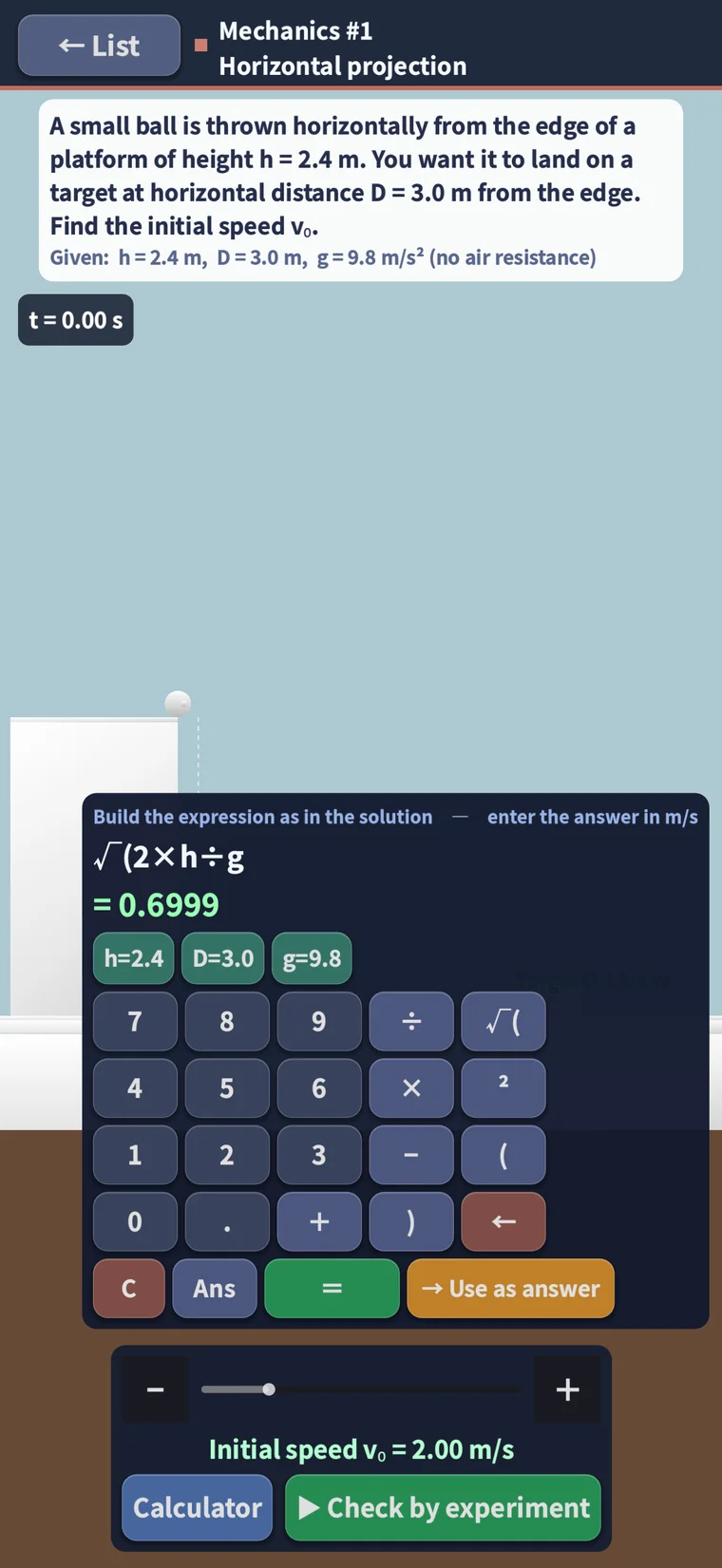
The built-in formula calculator turns the given values into buttons. Combine them with √ and parentheses to set up your equation, then send the result straight to the answer field. One hand, portrait mode, a minute or two per problem — spare moments become practice.
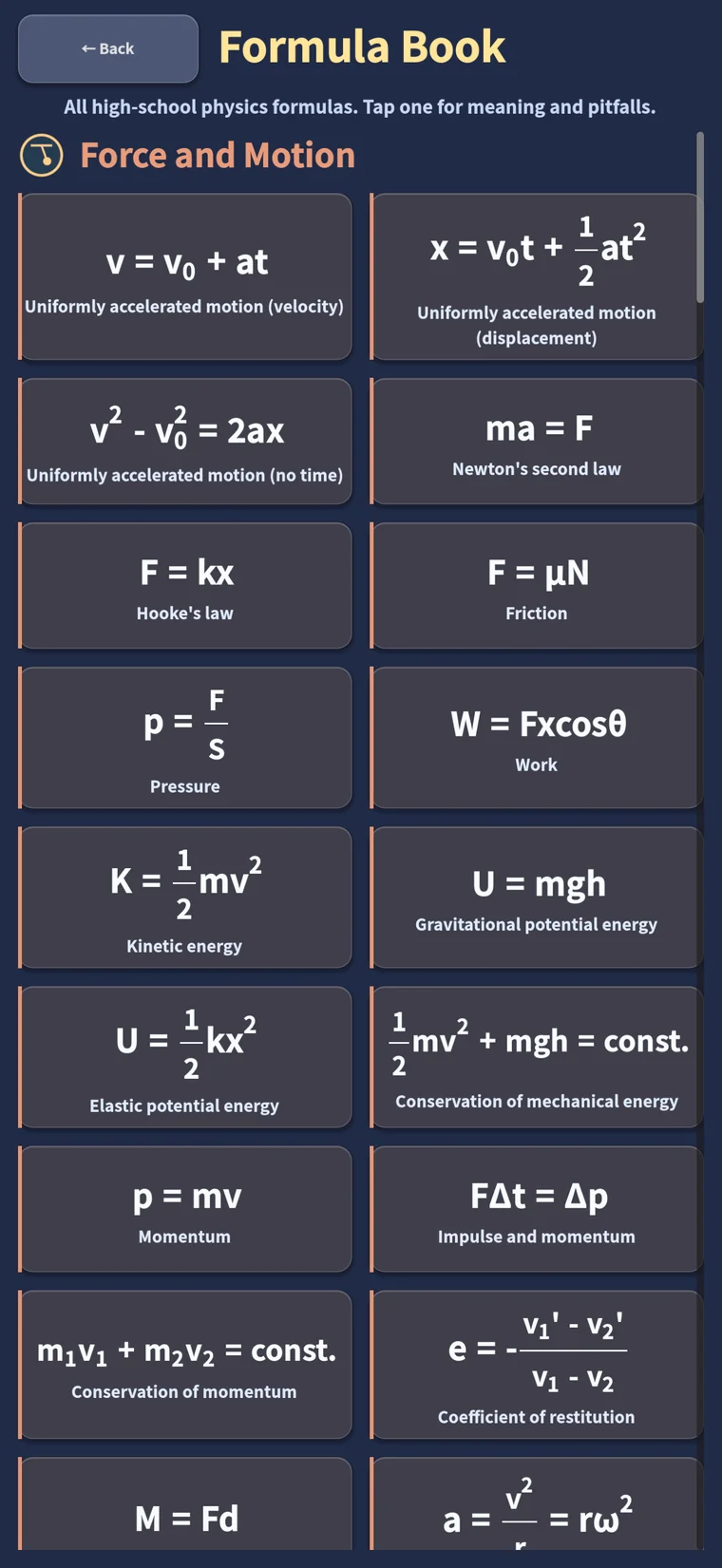
About 145 formulas, sorted by topic, each with its meaning and notes on where it strictly applies. The Formula Book is fully readable in the free version.
Six exam-style applied problems per field, each solved in two or three steps and each with a situation diagram. Take on six in a row with three hearts and earn a crown, then finish with a multi-part question that runs (1)→(2)→(3). The numbers change every time, so memorizing answers won't get you through. Topics include inertial forces, simple harmonic motion, adiabatic change, p-V cycles, Kirchhoff's laws, capacitor transients, RLC circuits, the Bohr model and nuclear reactions.
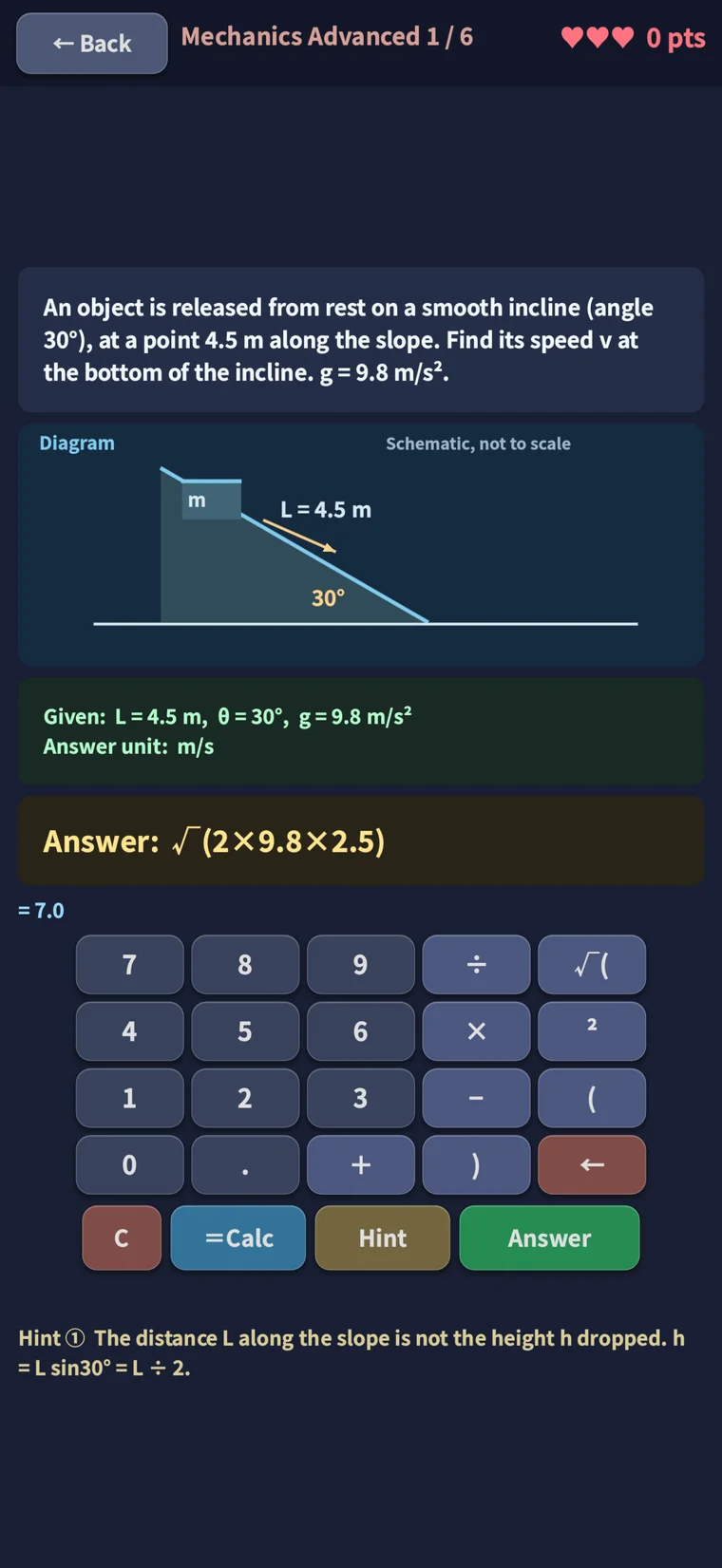
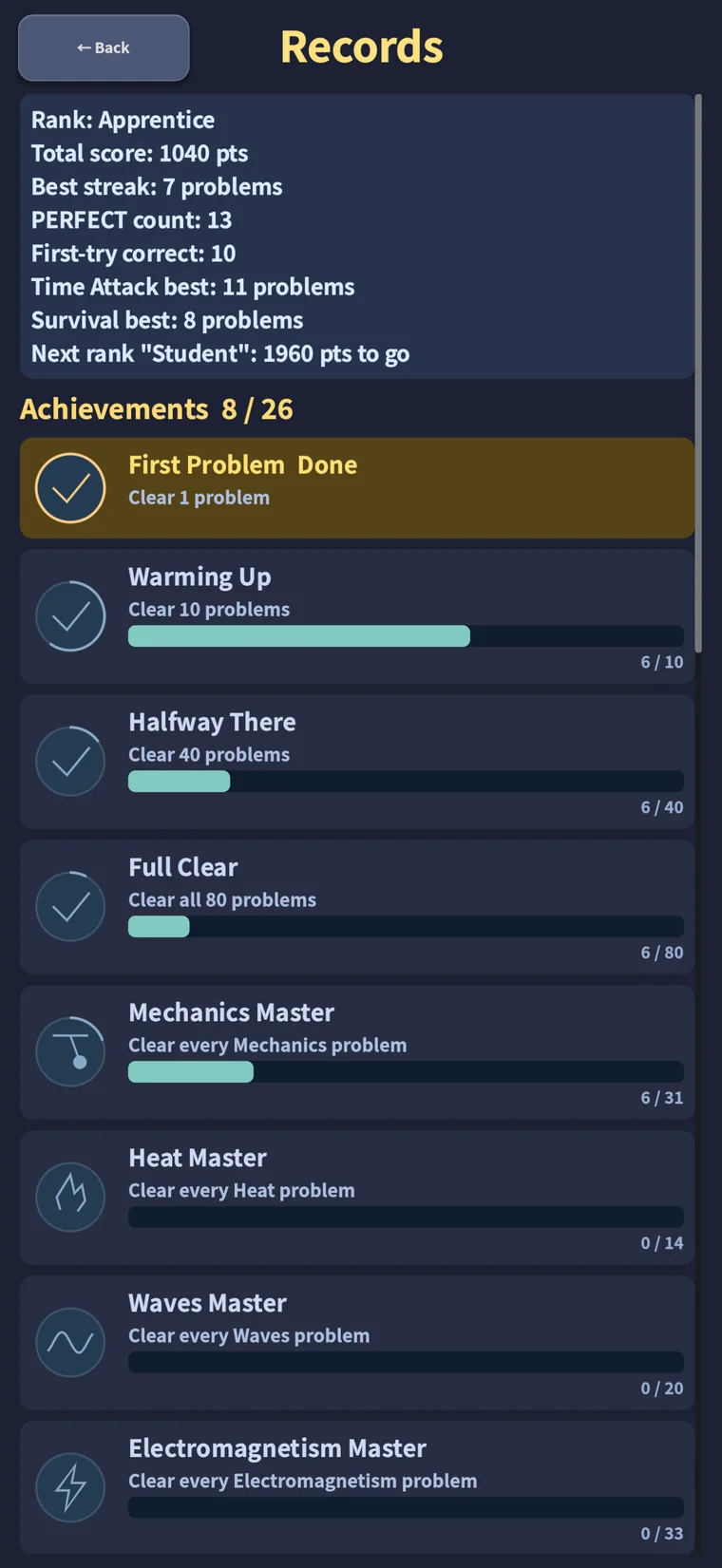
Problems you miss join Today's Review and return automatically after 1, 3, 7 and 16 days. There's also a 5-minute time attack, a survival challenge that runs until your first mistake, and 26 achievements.
The units follow the Japanese high-school physics curriculum, organized by field.
Made for — students who have memorized formulas without really getting them / anyone preparing for physics exams / people who want a quick review between classes / anyone who wants to see why it works with their own eyes
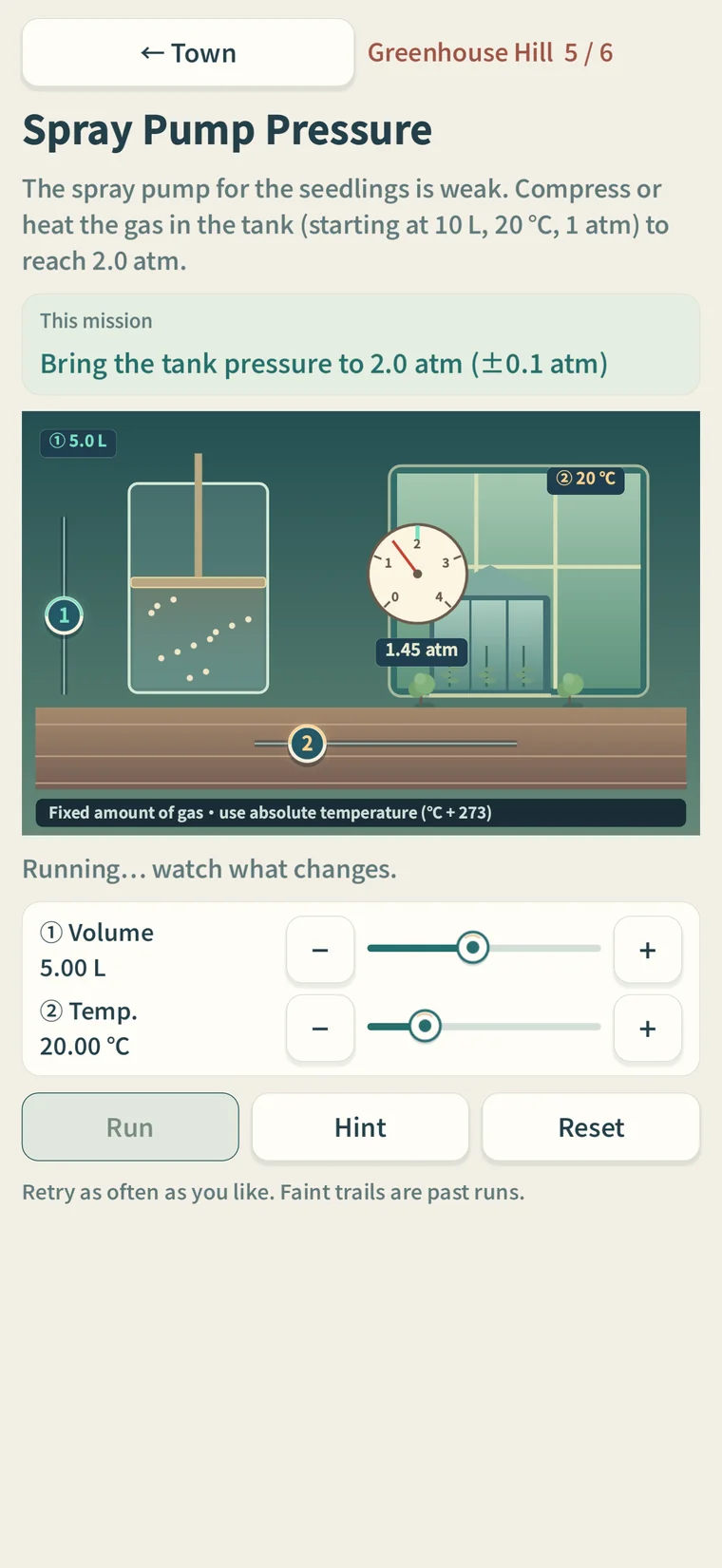
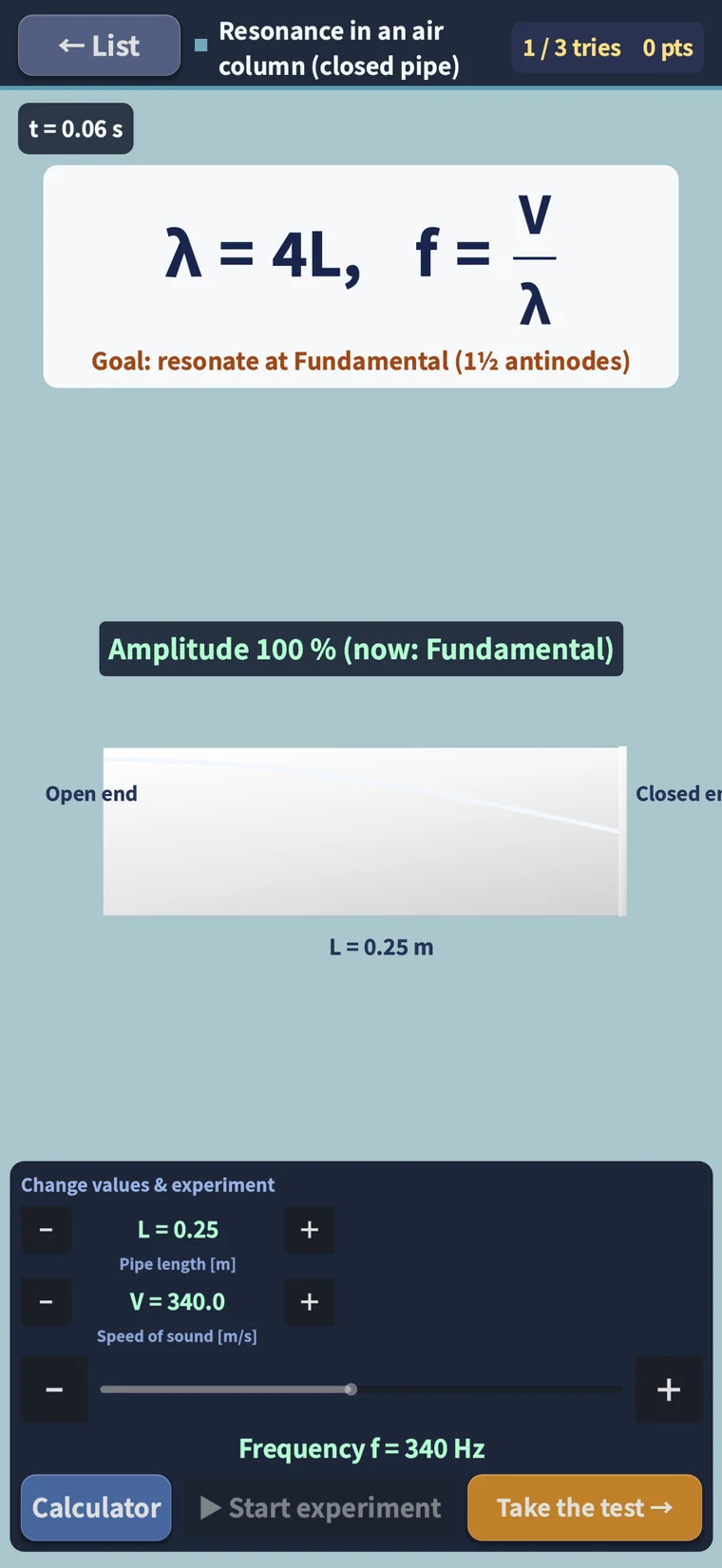
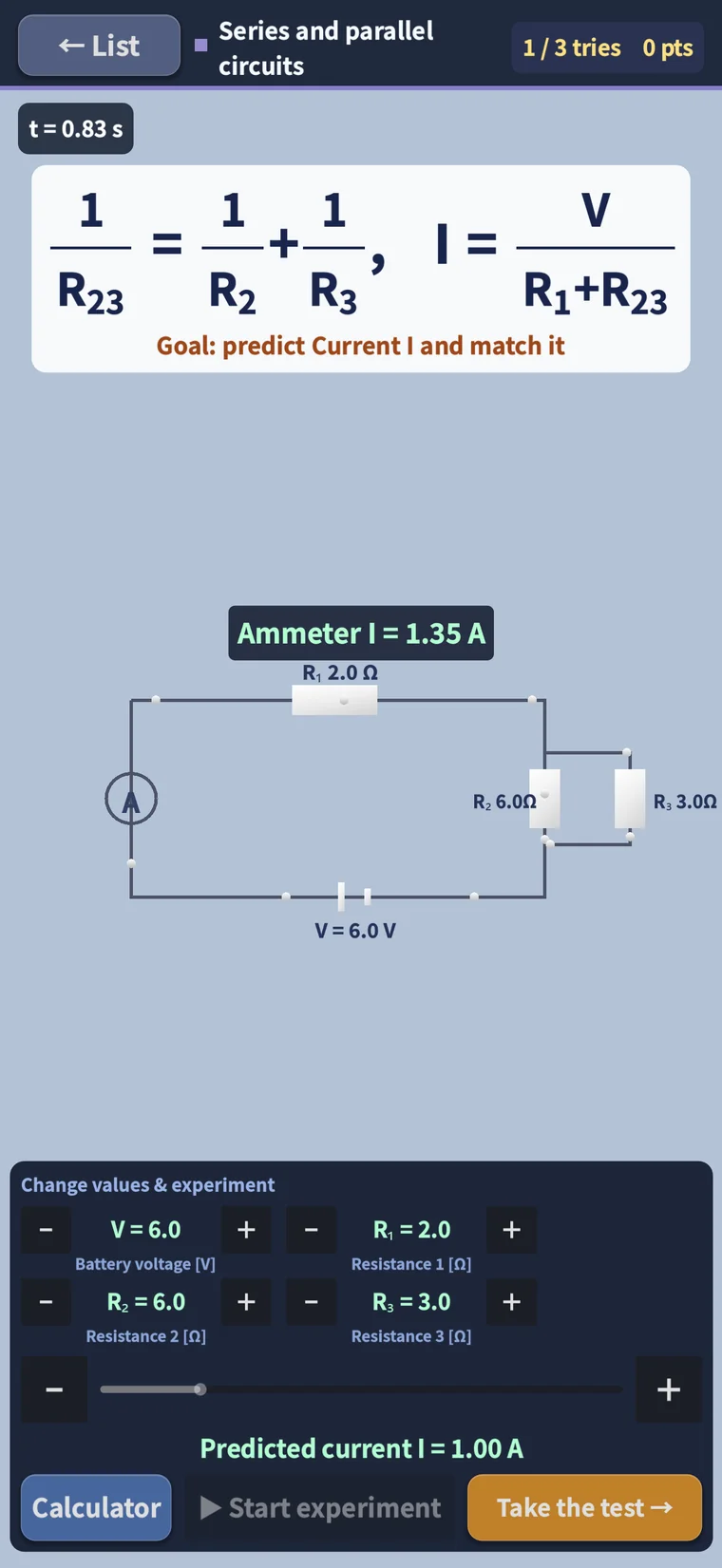
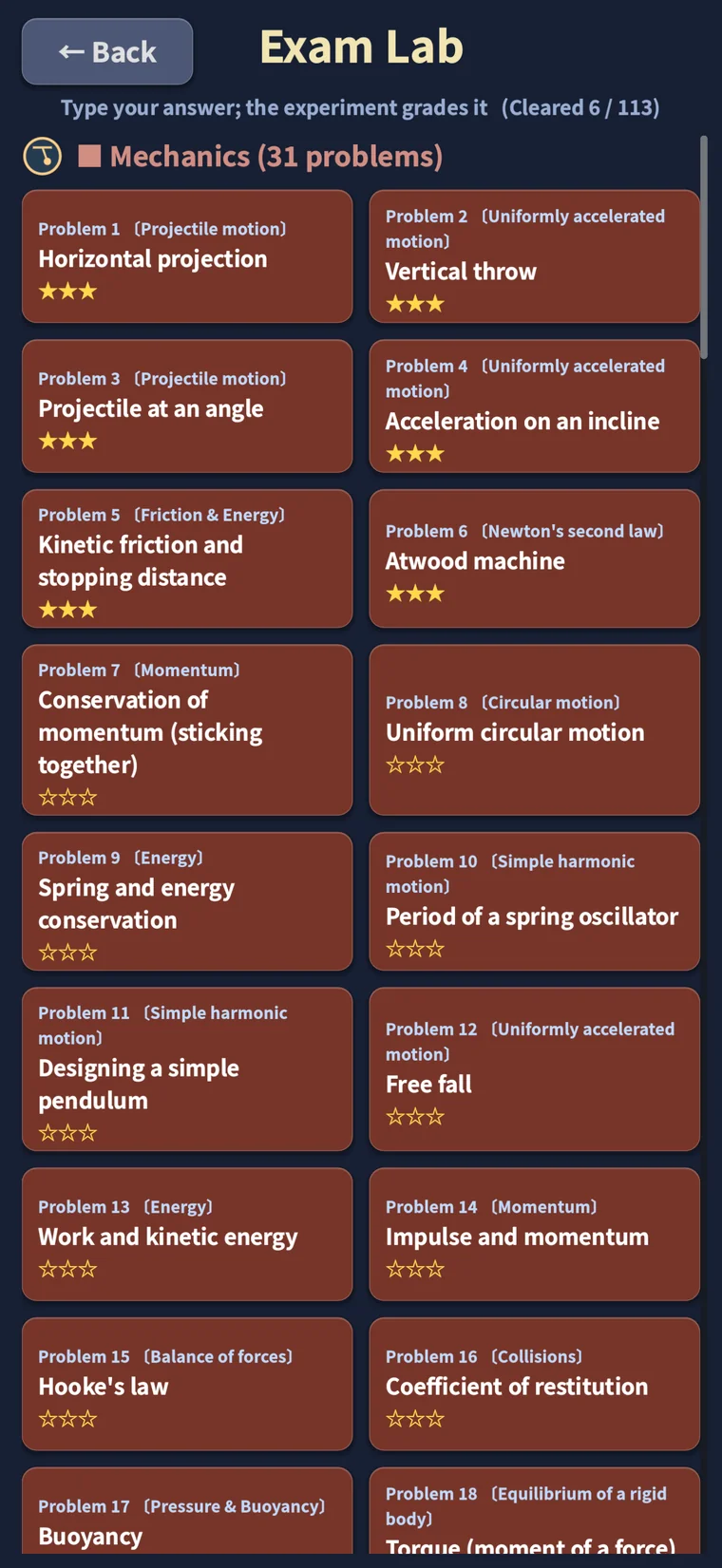
For anyone memorizing formulas without knowing what they mean. Enter the number you calculated and the experiment runs with it. Get it right and the cargo reaches the far shore; get it wrong and it falls short. No red marks, just the result in front of you. Physics makes sense once you touch it.
 SNAPLACE